Legacy software creates real problems for modern businesses. Systems built decades ago slow teams down, introduce security vulnerabilities, and buckle under the pressure of growth. Application modernization tools exist precisely to solve this, helping organizations update outdated infrastructure so it runs faster, stays secure, and scales without breaking.
Knowing where to start remains the hardest part of any modernization effort. Whether the goal is migrating to the cloud, refactoring code, or adopting a microservices architecture, teams need a clear plan rather than guesswork. CodeGiant's enterprise AI platform gives teams the guidance and support to assess, plan, and execute modernization in ways that align with their specific goals.
Table of Contents
-
What Role Does Automation Play in Application Modernization?
-
How to Measure the Success of an Application Modernization Project
-
How CodeGiant Simplifies Application Modernization with Enterprise AI
Summary
-
Organizations spend up to 80% of their IT budgets on maintaining legacy systems, leaving almost nothing available to build new capabilities. That ratio creates a structural problem, not a temporary one. When competitors are shipping faster, integrating AI, and scaling on demand, the cost of standing still becomes measurable and visible in ways that are difficult to ignore.
-
The global application modernization services market is projected to grow from USD 22.67 billion in 2025 to USD 51.45 billion by 2031, according to MarketsandMarkets. This scale of investment reflects a collective decision across industries, not a passing trend. Financial services, healthcare, and government sectors are among the most active, driven by compounding technical debt that inflates project costs by 10 to 20 percent before a single new feature ships.
-
Automation is not a peripheral benefit in modernization. It is the mechanism that makes transformation viable at enterprise scale. McKinsey research shows AI-assisted modernization accelerates timelines by 40 to 50 percent while cutting technology debt costs by more than 40 percent. Forrester's Total Economic Impact study on testing automation found 372 percent ROI and $6.3 million net present value over three years for a composite organization, with testing benefits accounting for $6.2 million of that figure.
-
Security exposure is one of the most underestimated drivers of modernization decisions. Legacy platforms were not built for modern threat surfaces, and the gap between what they protect and what attackers exploit widens every quarter they remain in place. Business Research Insights projects the application modernization services market will expand from USD 28.24 billion in 2026 to USD 104.71 billion by 2035, a trajectory driven in large part by organizations that can no longer absorb the compliance and breach risk of continued delay.
-
Talent loss compounds every other risk already present in aging systems. Skilled developers leave roles where most of their time is spent maintaining code that predates their careers, and the institutional knowledge they carry walks out with them. Organizations that delay modernization face a steeper learning curve with each new hire, fewer internal resources to manage the original system, and a shrinking window to capture that knowledge before it is gone entirely.
-
Treating modernization as a one-time replacement project rather than an incremental shift in capabilities is where most programs stall. Teams that extend what already exists, connecting systems, automating workflows, and layering new capabilities in stages, reach production-grade outcomes faster and with less disruption than those attempting full migration before realizing any value. CodeGiant's enterprise AI platform fits this approach by letting teams build apps, APIs, and automations directly on top of their existing stack, with compliance controls built into the architecture rather than added after the fact.
What Is Application Modernization and How Does It Work?
Application modernization is the process of updating legacy software systems to align with current platforms, architectures, and business needs. It moves outdated, monolithic applications toward cloud-native environments using microservices, containers, APIs, and automated workflows. The goal is to make existing systems work for modern operations without starting from scratch.

Why are so many organizations still running legacy systems?
Most organizations rely on software built for a different era, when updates happened every few months rather than daily and cloud infrastructure was a future consideration. According to DevOps.com, organizations spend up to 80% of their IT budgets maintaining legacy systems, leaving minimal resources for new features. This allocation is unsustainable when competitors release updates faster, integrate AI tools, and scale on demand.
How does the modernization process actually unfold?
The process starts by assessing your application portfolio: what each system does, its technical debt, and its maintenance costs. Teams then select a strategy matching the application's complexity and business value: migrating to the cloud, refactoring code, redesigning toward microservices, or replacing the system entirely. Each path involves different trade-offs between speed, cost, and scope of change. The critical decision is which strategy fits your actual risk tolerance and operational constraints, not which sounds best in theory.
Why treat modernization as incremental shifts rather than a one-time project?
Most teams treat modernization as a one-time migration project with a clear start and end. This approach creates pressure to finish the entire change before seeing benefits, slowing progress and increasing risk when unexpected problems arise. Platforms like CodeGiant's enterprise AI platform enable a different approach: our platform helps you build production-grade apps, APIs, agents, and automations directly on existing systems, so modernization becomes a series of gradual capability improvements rather than high-stakes replacement projects.
What core technologies power application modernization underneath?
Containerization packages applications into portable units that run consistently across environments. Microservices break large applications into independently deployable components, eliminating the need to update entire systems for changes. Serverless computing eliminates infrastructure management, allowing developers to focus on logic rather than capacity planning. According to DevOps.com, AI-assisted modernization can reduce migration time by up to 40%, transforming the economics for organizations that previously found modernization too time-intensive.
Why does what is application modernization remain difficult in practice?
What makes modernization difficult is not the technology, but the organizational assumption that transformation must be total before it can be meaningful. Successful modernization is a continuous practice: connecting systems, automating workflows, and extending capabilities in layers, rather than a single migration event.
Why Are Businesses Investing in Application Modernization?
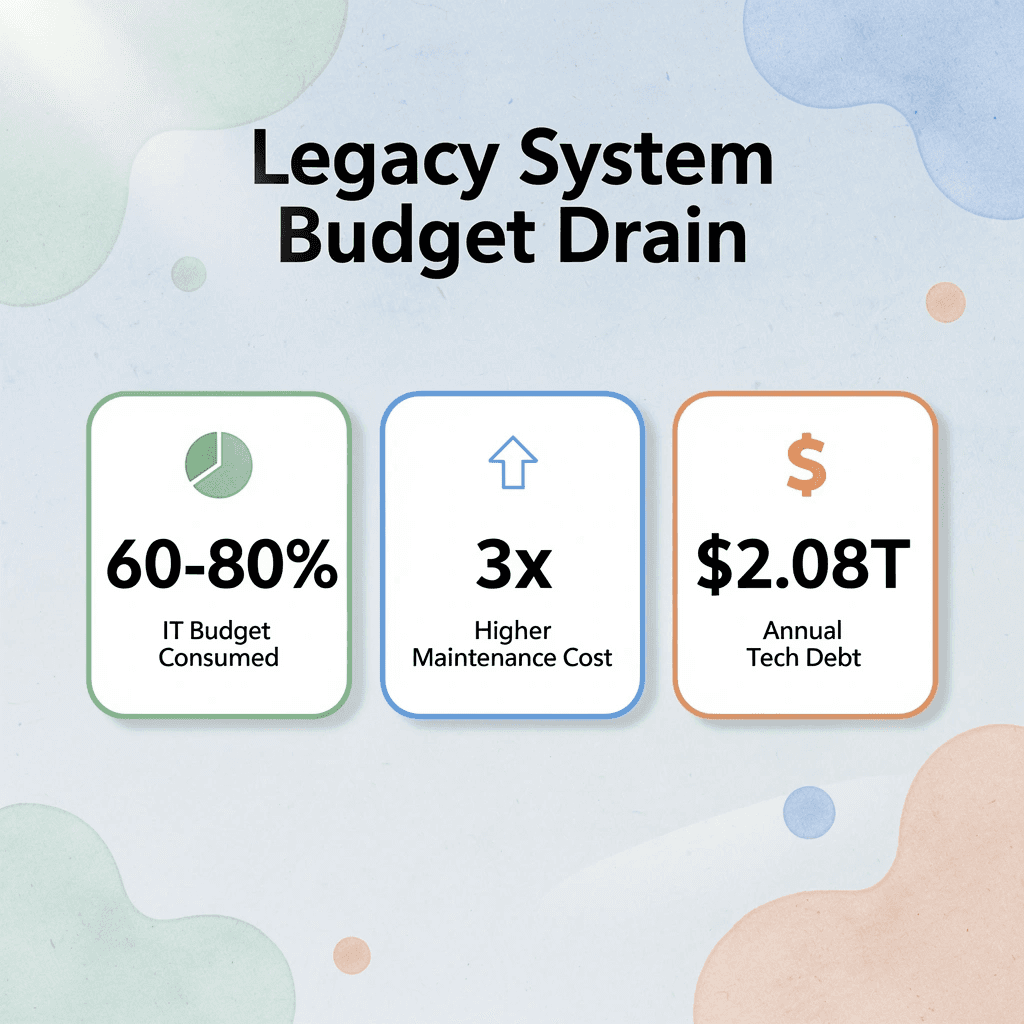
Businesses invest in application modernization because legacy systems redirect capital away from growth. When 60 to 80 percent of an IT budget disappears into maintaining aging infrastructure, nothing remains for building.
"When 60 to 80 percent of an IT budget disappears into maintaining aging infrastructure, there is nothing left to build with." — LegacyLeap, 2024
🚨 Warning: If your organization spends the majority of its IT budget on maintenance alone, you are funding the past, not investing in the future.
🔑 Takeaway: Application modernization isn't a luxury—it's a financial necessity. Redirecting even a fraction of that 60–80% maintenance spend toward modern infrastructure unlocks meaningful competitive growth.
The financial pressure is structural, not cyclical
Technical debt increases project costs by 10 to 20 percent across financial services, healthcare, and government before new features are released, with costs growing annually. According to MarketsandMarkets, the global application modernization services market is expected to grow from USD 22.67 billion in 2025 to USD 51.45 billion by 2031, reflecting widespread recognition of this problem and organizational action to address it.
What actually breaks first
The failure point is usually not the core system itself, but the connection points around it. Integration gaps, brittle APIs, and manual handoffs between departments create compounding delays that teams absorb silently until a missed deadline or compliance audit surfaces the problem. Most teams respond by building workarounds and custom scripts that solve immediate problems but add fragility to an unstable foundation.
As the organization grows and regulatory requirements tighten, those workarounds multiply until the system becomes unmanageable. Platforms like CodeGiant address this by enabling enterprises to build production-grade apps, APIs, and automations on top of their existing stack rather than dismantling it, so teams stop accumulating fragility and start building durable capabilities instead.
Security exposure accelerates the decision
Old systems carry risks that budget fixes cannot address. Legacy platforms were not built for today's threats, and the gap between what they protect and what attackers can exploit widens every quarter. Business Research Insights estimates the global application modernization services market will expand from USD 28.24 billion in 2026 to USD 104.71 billion by 2035, driven largely by organizations unable to manage compliance and breach risk. Regulatory penalties have forced entire sectors to treat modernization as mandatory rather than optional.
Talent leaves before the system does
Skilled developers do not stay in roles where most of their time is spent maintaining code older than their careers. The frustration stems from knowing exactly what a system should do while being blocked by limits without technical justification. Organizations that delay modernization face a growing talent problem: engineers who understood the old system retire or leave, institutional knowledge walks out with them, and new hires face steeper learning curves with fewer tools. That knowledge loss accelerates every other risk already present in the system.
Related Reading
- Application Modernization Tools
- Build Internal Tools
- Application Modernization Best Practices
-
Ai Governance
-
Mainframe To Cloud Migration
-
Build Internal Tools
-
Application Modernization Best Practices
-
Legacy System Modernization
-
Technical Debt Management
-
How To Modernize Legacy Systems
-
Legacy Software Modernization
What Role Does Automation Play in Application Modernization?
Automation is not a supporting character in application modernization—it is the core tool that makes change possible at the size and speed that big companies need. Without it, the sheer amount of old code, messy connections, and split-up workflows overwhelms even the strongest teams.
"Without automation, the volume of legacy code, tangled integrations, and fragmented workflows overwhelms even the most capable modernization teams." — Application Modernization Insight
💡 Tip: Treat automation as a first-class citizen in your modernization strategy—not an afterthought. Teams that embed automation early move faster and encounter fewer bottlenecks down the line.
🔑 Takeaway: Application modernization at enterprise scale is practically impossible without automation. It is the difference between a transformation that stalls and one that delivers results.
|
Without Automation |
With Automation |
|---|---|
|
Manual code reviews slow progress |
Automated scanning accelerates discovery |
|
Human error in repetitive migrations |
Consistent, repeatable execution |
|
Teams overwhelmed by legacy complexity |
Structured workflows manage scale |
|
Slow, costly modernization cycles |
Faster delivery at reduced risk |
How does automated discovery compress what application modernization actually requires?
Looking at code by hand across millions of lines takes months. Automated discovery tools complete that work in days, revealing dependency maps, dead code, and integration risks that human reviewers would miss. McKinsey research shows AI-assisted modernization accelerates timelines by 40 to 50 percent while cutting technology debt costs by more than 40 percent: a significant impact.
Why does testing automation create the largest measurable impact?
Forrester's Total Economic Impact study found a 372 percent return on investment and $6.3 million net present value over three years for a composite organization, with testing benefits accounting for $6.2 million of that total. This fundamentally changes what teams can safely release and how often.
How do CI/CD pipelines remove deployment fragility during modernization?
Most teams handle deployment through manual approvals, environment-specific scripts, and knowledge held by senior engineers. CI/CD pipelines and infrastructure-as-code remove that fragility by encoding deployment logic into repeatable, auditable processes. An enterprise AI platform like CodeGiant extends this further: our platform lets teams build production-grade apps, APIs, and automations on their existing stack, enabling incremental modernization without dismantling systems that keep the business running.
How does automation solve the institutional knowledge problem in legacy teams?
Automation platforms solve the talent problem by capturing institutional knowledge in workflows, templates, and reusable components, making expertise available to the whole team rather than locked inside one person's head. A Deloitte engagement with a food services company boosted team efficiency by approximately 50 percent by replacing manual processes with automated ones, critical leverage in organizations where original system engineers have already departed.
What surprises most leaders is not that automation helps, but how deeply it changes what modernization means once you use it at scale.
Related Reading
- As400 Modernization
- Enterprise Ai Governance
- Public Sector Digital Transformation
- Mendix Alternatives
- OutSystems Alternatives
- Appian Pricing
- Ai Agent Pricing
- Outsystems Vs Mendix
How to Modernize Applications Step by Step
Application modernization works best when you have a clear, structured plan. Each step lowers risk, keeps your business running smoothly, and creates faster, more secure, easier-to-maintain applications.
"A well-executed modernization roadmap ensures every phase builds on the last — minimizing disruption while maximizing long-term value." — Application Modernization Best Practices
💡 Tip: Follow a step-by-step approach to modernization — skipping steps is the most common reason projects go over budget and over schedule.
⚠️ Warning: Attempting to modernize without a clear plan can leave your business exposed to downtime, security vulnerabilities, and costly rollbacks.
|
Modernization Goal |
Key Benefit |
|---|---|
|
Risk Reduction |
Fewer outages and failures during transition |
|
Business Continuity |
Operations stay smooth throughout the process |
|
Faster Performance |
Optimized apps deliver quicker results |
|
Improved Security |
More secure architecture reduces vulnerabilities |
|
Easier Maintenance |
Cleaner codebases save time and money in the long term |
⚡ Pro Tip: Treat each modernization step as a checkpoint — validate success before moving forward to ensure your business stays protected at every stage of the journey.

Assess Your Current Application Portfolio
Start by listing all applications with their technology stacks, dependencies, performance metrics, business value, and technical debt. Analyze maintenance costs, scalability limitations, security vulnerabilities, integration points, and alignment with business objectives. Use code analysis tools, dependency mapping, and stakeholder interviews to create a prioritized list identifying quick-win candidates versus complex undertakings.
Define Clear Objectives and Success Metrics
Match your modernization efforts to specific business goals: reducing operational costs, accelerating feature delivery, improving customer experiences, or meeting compliance requirements. Set up measurable KPIs including deployment frequency, reduced downtime, cost savings targets, scalability benchmarks, and user satisfaction scores. Involve stakeholders from IT, business units, and leadership to create shared ownership and guide decision-making.
Select the Optimal Modernization Strategy
Look at the 7 Rs framework—Retire, Retain, Rehost, Replatform, Refactor, Rearchitect, and Rebuild—to match each application with the approach that best aligns with its business value, technical condition, and organizational constraints. Rehost stable applications for quick cloud migration, while refactoring or rearchitecting high-value monoliths into microservices unlocks greater agility. Consider timelines, costs, risks, team skills, and desired outcomes such as cloud-native capabilities or AI integration.
Develop a Detailed Roadmap and Phased Plan
Create a realistic, step-by-step roadmap with prioritized phases, timelines, resource requirements, budget allocations, and risk mitigation strategies. Break work into manageable iterations using patterns like the strangler fig to gradually replace legacy components. Include data migration plans, testing strategies, rollback procedures, and change management activities. This phased structure maintains business continuity while building momentum through visible successes.
Build Skills, Select Tools, and Prepare the Team
Invest in improving skills through focused training on cloud platforms, containers, microservices, DevOps practices, and modern architectures. Choose supporting technologies such as Kubernetes for organizing resources, CI/CD pipelines for automation, and monitoring tools for observability. Encourage collaboration between development, operations, and security teams. Tools like CodeGiant help teams modernize, extend, or build production-grade apps and AI agents directly on existing stacks, with full control, compliance, and seamless integrations with systems like Salesforce, Postgres, and Slack, accelerating transformation without sacrificing governance.
Execute the Modernization Iteratively
Put your chosen strategies into action through code updates, containerization, cloud migration, or architecture redesigns. Use automated testing, continuous integration, and staged deployments to reduce errors. Monitor progress against the roadmap, address issues quickly, and adjust based on real-time feedback. This step-by-step approach minimizes disruption, enables learning and refinement, and ensures each phase delivers clear improvements.
Test Thoroughly, Deploy, and Optimize
Conduct functional, performance, security, and integration testing in staging environments that mirror production. Ensure smooth transitions with minimal downtime, then move to ongoing operations with enhanced monitoring, logging, and automated scaling. Collect user feedback and performance data to drive continuous improvement through resource optimization and feature additions.
Govern, Measure, and Iterate Continuously
Set up governance frameworks to manage operations on an ongoing basis, ensure compliance with all rules and regulations, and control costs. Track KPIs against your original goals regularly, celebrate successes, and identify which applications to modernize next. Build a culture where teams improve by applying lessons from past projects to future ones.
How to Measure the Success of an Application Modernization Project
Finishing an application modernization project is only half the work. Real success means the modernized application delivers better business results, improves operations, and creates long-term value. Tracking the right measurements determines whether the investment achieved its intended goals and identifies areas that need improvement.
"Real success means the modernized application delivers better business results, improves operations, and creates long-term value — not just a completed migration." — Application Modernization Best Practices
🎯 Key Point: A modernization project isn't truly complete until you can measure and prove that it delivered on its intended business outcomes.
⚠️ Warning: Failing to define success metrics before launch is one of the most common mistakes teams make — leaving them unable to justify the ROI of modernization after the fact.
|
Success Dimension |
What to Measure |
Why It Matters |
|---|---|---|
|
Business Results |
Revenue impact, cost savings |
Proves financial ROI |
|
Operational Efficiency |
Deployment speed, downtime reduction |
Shows performance gains |
|
Long-Term Value |
Scalability, maintainability |
Validates strategic investment |
Establish Baseline Metrics Before Starting
Collect detailed information before modernizing your application. Track application response times, error rates, infrastructure costs, deployment frequency, downtime incidents, user satisfaction scores, and maintenance expenses. Document technical debt levels, scalability limits, and business process efficiency through audits and stakeholder input. These baseline metrics provide objective reference points for calculating improvements and ROI, ensuring all success claims rest on verifiable before-and-after comparisons.
Track Technical Performance Improvements
Watch key metrics: lower latency, higher throughput, better uptime, faster query response times, and fewer errors. Test scalability using automated load testing to assess how the modernized application handles increased traffic. These indicators demonstrate that the new architecture is more reliable and efficient, resolving legacy issues and supporting critical operations.
Measure Operational Efficiency Gains
Look at changes in deployment frequency, lead time for changes, recovery time from failures, and developer productivity. Track reductions in infrastructure and maintenance costs through cloud optimization and automation. These improvements free up resources, accelerate innovation cycles, and demonstrate how modernization simplifies IT processes for greater organizational agility.
Evaluate Business and Financial Outcomes
Calculate ROI by comparing total modernization costs against savings in operations, increased revenue from faster feature delivery, improved customer retention, and new opportunities enabled by enhanced capabilities. Monitor business-specific KPIs such as transaction volumes processed, customer satisfaction (CSAT or NPS) scores, and time-to-market for new functionalities. These metrics link technical upgrades to bottom-line results.
Assess User Adoption and Experience
Collect feedback through surveys, usage analytics, and engagement data to measure adoption rates, feature usage, session duration, and user satisfaction. Track support ticket volume and improvements in accessibility and mobile responsiveness. Strong metrics demonstrate that the modernized application delivers better technical performance and user experience.
Review Security, Compliance, and Risk Reduction
Measure security improvements by tracking vulnerability scan results, incident frequency, compliance audit pass rates, and threat resolution speed. Monitor data protection enhancements and adherence to standards like GDPR and industry-specific regulations. These metrics demonstrate how modernization strengthens systems against cyber attacks and regulatory risks.
Monitor Long-Term Scalability and Innovation Impact
Assess how well new technologies, such as AI or analytics, integrate with your system, and measure the ease of adding future features using a modular architecture or microservices. Track costs over time, the system's adaptability to business changes, and feature velocity post-modernization. Platforms like CodeGiant enable teams to modernize, extend, or build production-grade apps and agents on existing stacks with full control and compliance, accelerating innovation while maintaining governance across enterprise systems.
Conduct Regular Reviews and Continuous Improvement
Plan regular check-ins at important points and after the project ends to compare achievements against goals. Gather feedback from your team and users through dashboards that track real-time progress and meetings to discuss lessons learned. Apply these insights to improve your process for future projects, sustain benefits, and establish modernization as a repeatable organizational capability.
How CodeGiant Simplifies Application Modernization with Enterprise AI
CodeGiant makes it easier to update old applications by using what you already have as a starting point, not as a problem. Our enterprise AI platform adds workflow automation and production-grade tools directly on top of legacy systems. This way, organizations can move forward without the disruption that usually stops multi-year migration programs.
"Organizations can move forward without the disruption that usually stops multi-year migration programs — by building on top of legacy systems, not tearing them down." — CodeGiant
🎯 Key Point: CodeGiant treats your existing infrastructure as a foundation, not a liability — enabling modernization without migration chaos.
💡 Tip: If your organization has been stalled by the complexity of full-system overhauls, workflow automation layered onto legacy systems is the fastest path to production-grade results without starting from scratch.
|
Traditional Migration |
CodeGiant Approach |
|---|---|
|
Replaces legacy systems entirely |
Builds on top of existing systems |
|
High disruption risk |
Minimal disruption to operations |
|
Multi-year timelines |
Accelerated modernization path |
|
Requires full re-architecture |
Workflow automation added directly |
[IMAGE: https://im.runware.ai/image/os/a10dlim3/ws/3/ii/d91be2c0-cd6b-474a-ac11-97cc0a2bb343.webp] Alt: Before and after infographic showing transformation from legacy systems to AI-powered applications

Where does application modernization typically stall in enterprise environments?
The failure point is usually not the technology itself, but the gap between what AI can theoretically do and what a governed, production-ready system requires. Most teams achieve promising sandbox results, then spend months hardening them for enterprise use. Compliance requirements, audit trails, and integration dependencies stall progress. Our enterprise AI platform reduces application modernization time by up to 40%, but capturing that reduction requires governance engineered from the start, not bolted on afterward.
How does deterministic automation make modernization viable for regulated industries?
CodeGiant's enterprise AI platform solves this problem by keeping automation predictable and trackable while using AI to generate content. Every action can be followed and every result verified. For regulated industries like banking, insurance, and healthcare, our platform's design determines whether AI moves from testing to production deployment.
What makes the compliance layer different?
The insurance sector exemplifies this clearly. Underwriting and claims workflows involve layered policy logic, approval chains, and regulatory checkpoints that cannot tolerate ambiguity. According to CodeGiant's Insurance Modernization and Transformation FAQ, 100% of claims decisions are logged, with every AI plan, approval, and policy validation recorded before any workflow runs. Compliance is structural rather than procedural.
How does integration prevent modernized systems from becoming new silos?
Modernization delivers lasting value only when it connects systems rather than isolating them. A modernized claims engine that cannot communicate with your CRM, billing platform, or notification layer remains a silo. CodeGiant's integration layer connects to hundreds of tools across enterprise ecosystems, enabling workflows that span systems, trigger on events, apply AI scoring, and route decisions automatically.
When does application modernization stop being a cost center?
Modernization stops being an expense when rebuilt systems create measurable improvements in processing speed, data accuracy, and operational coverage within weeks rather than quarters.
Try CodeGiant's Enterprise AI Platform Today
Teams that choose a governed, incremental path reach production-grade outcomes in weeks, not quarters. CodeGiant's enterprise AI platform is built for that moment — when strategy is clear, and execution is next. Our Harness Engine, App Builder, and Workflow Builder extend your existing stack with powerful new capabilities, offering one-click deployment to AWS, Azure, or Google Cloud with built-in compliance controls.
"Teams that choose a governed, incremental path reach production-grade outcomes in weeks, not quarters — not the drawn-out timelines of traditional enterprise transformation." — CodeGiant
|
Platform Component |
Core Capability |
Deployment Target |
|---|---|---|
|
Harness Engine |
Governed AI orchestration |
AWS, Azure, Google Cloud |
|
App Builder |
Rapid application development |
One-click cloud deployment |
|
Workflow Builder |
Stack extension & automation |
Existing infrastructure |
🎯 Key Point: CodeGiant's three-part platform — Harness Engine, App Builder, and Workflow Builder — is designed to extend what you already have, not replace it.
The process takes minutes to begin, with no upfront commitment required. Visit codegiant.io to see how CodeGiant helps financial services, healthcare, government, and manufacturing teams modernize without rip-and-replace disruption. Your legacy systems don't become a liability; they become the foundation you build on.
💡 Tip: Whether you're in regulated industries like healthcare or government, or scaling operations in financial services or manufacturing, CodeGiant's built-in compliance controls let you move fast without sacrificing governance or security.
✅ Best Practice: Start your CodeGiant deployment today. With no upfront commitment and onboarding measured in minutes, you can begin your enterprise AI transformation immediately.
Related Reading
- Application Modernization Roadmap
-
Insurance Legacy Modernization
-
.net Modernization
-
Enterprise Architecture Modernization
-
Cobol Replacement
-
Iseries Modernization
-
Application Modernization Benefits
-
Rpg Modernization