As AI becomes central to enterprise operations, the pressure to use it responsibly has never been higher. Organizations are moving quickly to embed AI into their workflows, but without clear policies around data privacy, model accountability, and regulatory compliance, adoption can create more risk than value. A strong AI governance framework addresses all of this, giving teams a structured way to scale AI safely and with full confidence in how it is being used.
Good governance is not just about avoiding mistakes. It is about building the trust that allows organizations to move faster and make better decisions. Teams that get this right can enforce usage policies, maintain transparency across all models, and stay compliant without slowing innovation. For organizations ready to take that step, CodeGiant's enterprise AI platform provides the oversight and structure needed to manage AI at scale.
Table of Contents
-
What Is AI Governance and Why Is It Important for Enterprises?
-
What Are the Core Principles of AI Governance?
-
What Does an AI Governance Framework Include?
-
How to Build an Effective AI Governance Strategy
-
AI Governance Best Practices for Enterprise Teams
-
How CodeGiant Simplifies Enterprise AI Governance
-
Try CodeGiant's Enterprise AI Platform Today
Summary
-
AI governance software spending is projected to grow at a 30% compound annual growth rate through 2030, reaching $15.8 billion, according to Forrester. That trajectory reflects a shift in how enterprises are treating governance: not as a compliance cost but as the structural foundation that makes AI trustworthy enough to deploy at scale. Organizations that build governance in early move from pilots to enterprise-wide deployment with measurably more confidence.
-
Transparency remains the most valued principle in AI governance, with 72% of organizations identifying it as the most critical factor according to Knostic AI's 2025 research. When a model produces an output that no one can trace back to its source, the organization cannot audit it, improve it, or defend it to regulators or customers. Documentation of data sources, model logic, and decision rationale across the full AI lifecycle is what separates a system you can stand behind from one that creates quiet liability.
-
Fairness and bias mitigation remain significantly underimplemented despite their stakes. Only 35% of companies have fully integrated these controls into their AI governance frameworks, according to Knostic AI's 2025 data. AI systems trained on historical data inherit historical biases, and without deliberate, continuous testing, those biases shape consequential decisions in hiring, lending, and healthcare access long before anyone inside the organization notices the pattern.
-
The gap between AI adoption and governance infrastructure is substantial. According to AIGN.Global, 77% of organizations have AI initiatives underway, but only 25% have a formal AI governance framework in place. That gap is not primarily a planning failure. It is a structural one, where AI development outpaces the oversight mechanisms, accountability roles, and policy enforcement needed to manage it responsibly.
-
Over 70% of AI governance frameworks now incorporate data privacy and compliance components, reflecting how quickly regulators have moved from issuing guidance to active enforcement. Amazon's AI recruiting tool, which systematically downgraded resumes containing women's names, illustrates precisely what happens when data governance is treated as secondary rather than foundational. The failure typically originates upstream in training data and lineage gaps, not in the model itself.
-
Continuous oversight after deployment is where most governance programs fall short. Deloitte's research reports that only one in five companies maintains a mature governance model for autonomous AI agents even as usage surges, meaning the majority are running systems that have already outpaced their controls. Model drift, data distribution shifts, and changing regulatory requirements mean that a system performing well at launch can become a liability within months without structured monitoring.
-
CodeGiant's enterprise AI platform addresses this by embedding policy checks, human-in-the-loop approvals, audit trails, and access controls directly into the development workflow, so governance is a structural property of every AI output rather than a checkpoint added after the fact.
What Is AI Governance and Why Is It Important for Enterprises?
Your team is already using AI in production. Code gets written, reports get generated, customer decisions get made. Then something breaks. A model surfaces biased output in a lending decision. A prompt pulls in data it was never supposed to see. An automated report is sent to a client with unverified numbers. These failures occur when AI scales faster than the structures built to manage it.

What does AI governance actually cover across the enterprise?
AI governance is the set of policies, processes, and oversight mechanisms that keep AI systems accountable across their entire lifecycle, from initial model training to production deployment and running in production. It determines whether AI creates lasting value or unpredictable liability.
Why does AI Governance determine where risk management breaks down?
The failure point is invisible until it isn't. Biased training data produces discriminatory outcomes in hiring pipelines or credit scoring systems. Security gaps in prompt design allow sensitive customer information to surface unexpectedly. Without structured model risk management, algorithmic accountability, and data lineage, vulnerabilities compound silently. By the time they become visible, the cost is reputational, legal, and financial.
How does AI Governance close the gap left by informal oversight?
Most enterprise teams handle AI oversight through informal review processes, spreadsheet-based tracking, and post-deployment audits. This works with isolated tools, but when AI embeds across banking, healthcare, or government workflows, the same approach creates audit gaps, inconsistent policy enforcement, and compliance exposure. Enterprises using CodeGiant's enterprise AI platform embed governance directly into the platform: it enforces policies, controls access, and tracks usage before anything reaches production.
The trust equation
Forrester forecasts AI governance software spending will grow at a 30% compound annual growth rate through 2030, reaching $15.8 billion. This reflects a fundamental shift: organizations now recognize governance as essential to scaling trustworthy AI. Customers demand responsible data handling. Regulators require audit trails and decision explainability. Internal teams need reliable outputs. Governance addresses all three through a single structural commitment.
Why does AI governance become a competitive advantage?
Organizations that treat governance as a foundation rather than a filter move from pilots to company-wide deployment with confidence. They move faster because they know what AI is doing. This confidence, built on transparent systems, responsible practices, and clear accountability, becomes a competitive advantage. But knowing why governance matters is only the beginning. The harder question is what governance looks like when built to last.
What Are the Core Principles of AI Governance?
Five principles form the foundation of effective AI governance: transparency, fairness, accountability, privacy, and reliability. Together, they transform AI from a risk into a controlled, auditable asset that enterprises can defend to regulators, customers, and their boards.

Transparency and Explainability
According to Knostic AI's 2025 AI Governance Statistics, 72% of organizations say transparency is the most critical principle in AI governance frameworks. When a model produces a result that cannot be traced to its source, the organization cannot verify, improve, or defend it. Transparency means maintaining clear records of data provenance, model mechanics, and decision rationale throughout the AI lifecycle: the difference between a system you can stand behind and one you hope remains unquestioned.
Why does AI Governance require active fairness and bias mitigation?
AI systems trained on historical data absorb historical biases. Without careful testing against measures like demographic parity, these biases shape decisions in hiring, lending, and healthcare access. Knostic AI's 2025 research reports that only 35% of companies have integrated fairness and bias mitigation into their AI governance core principles. This governance gap creates legal exposure and reputational risk.
How can continuous monitoring close the AI Governance gap?
Manual bias reviews miss the changes that accumulate between checks as AI systems expand across departments. Our CodeGiant platform addresses this by embedding governance controls directly into production, enabling continuous fairness checks and audit trails without slowing deployment.
Accountability, Privacy, and Reliability
Accountability means assigning a named owner to every AI decision path. Without it, organizations discover accountability only after failure—the worst time to learn who approved the model, which dataset it used, and what the escalation path should be. Privacy and data security enforce strict access controls and consent management to protect sensitive information from external breaches and internal misuse. Reliability demands that systems perform consistently under real-world conditions, not only in controlled testing environments.
How do these AI Governance principles reinforce each other?
These five principles form a connected system where a gap in one weakens the others. A reliable model that nobody can explain poses a governance risk. A transparent model without accountability leaves the organization exposed when something goes wrong. AI governance strength comes from how these principles reinforce each other across the full model lifecycle: from training data selection through deployment, monitoring, and decommissioning.
Why is operationalizing AI Governance harder than it looks?
Putting these ideas into practice in a real company with different teams, legacy systems, and established rules is harder than knowing about them.
Related Reading
- Build Internal Tools
-
Mainframe To Cloud Migration
-
Legacy Software Modernization
-
Cobol To Java
-
Build Internal Tools
-
Application Modernization Best Practices
-
Technical Debt Management
-
Ai Governance
-
Legacy System Modernization
What Does an AI Governance Framework Include?
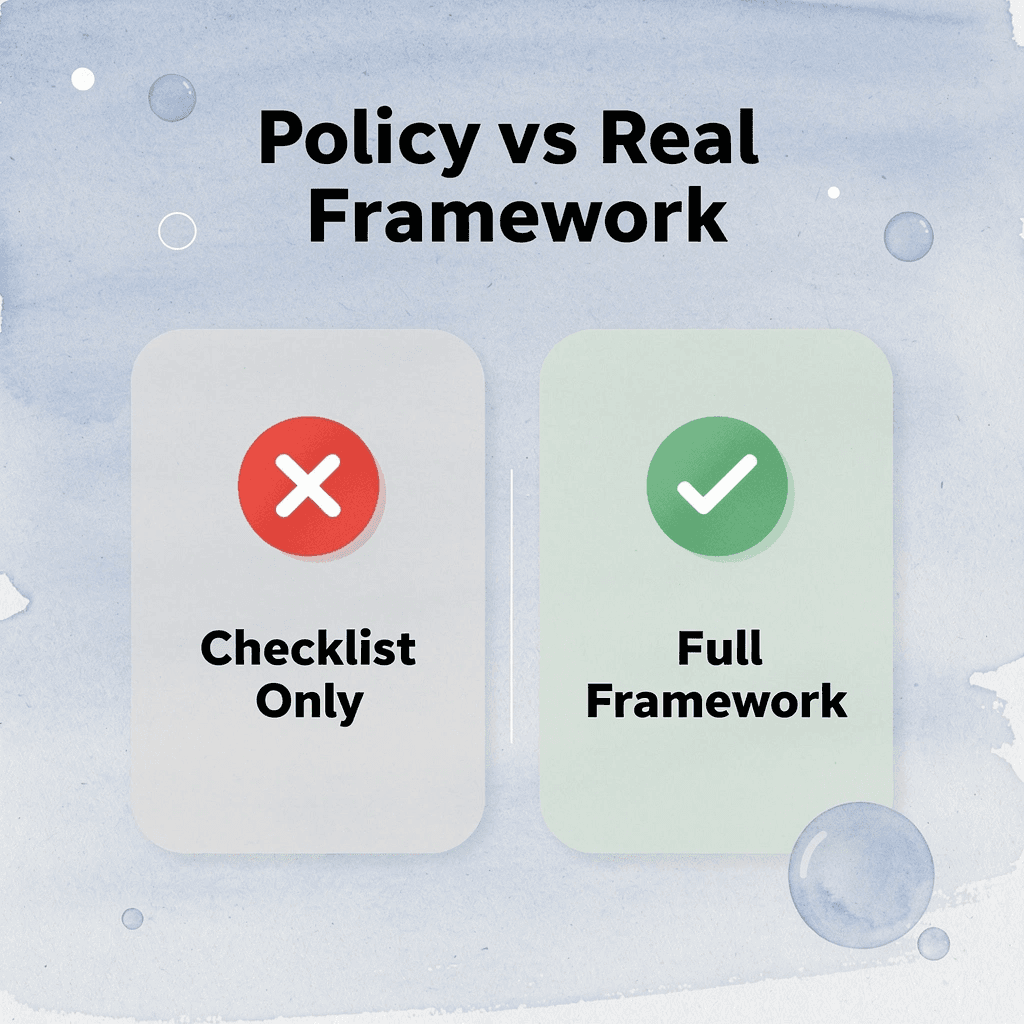
Many leaders mistakenly think that basic policies or a checklist will cover everything needed for AI governance. This doesn't work because policies that stand alone fail to address how AI systems connect and work together at a large-company scale. A real framework brings together strategy, processes, and controls across the whole lifecycle, closing gaps that can turn good ideas into expensive failures.
"A real AI governance framework brings together strategy, processes, and controls across the whole lifecycle — stopping the gaps that turn good ideas into expensive failures."
🎯 Key Point: A standalone policy or checklist is not a governance framework — it's a starting point at best. True AI governance requires end-to-end integration across every stage of an AI system's lifecycle.
⚠️ Warning: Companies that rely on policy documents alone are leaving critical gaps in how their AI systems interact, scale, and fail — gaps that can result in serious operational and reputational damage.
|
Approach |
What It Covers |
Key Weakness |
|---|---|---|
|
Checklist / Basic Policy |
Surface-level rules |
Misses system-level interactions |
|
Siloed Controls |
Individual AI tools |
Fails at enterprise scale |
|
Real Governance Framework |
Strategy, processes, and controls across the full lifecycle |
Requires ongoing commitment |
Governance Structures and Roles
Good AI governance requires dedicated committees, cross-functional oversight teams, and executive-level accountability, written into charters rather than suggested by job titles. These structures define who approves models for production, who handles escalation when systems behave unexpectedly, and how often they are reviewed. Without this framework, responsibility diffuses until a high-profile incident forces a reckoning that could have been prevented months earlier.
Policies, Risk Management, and Compliance
The policy layer turns ethical commitments into enforceable rules: written standards for how models are developed, when they can be used, and what they can be used for, aligned with legal requirements like data protection laws and industry-specific regulations. Knostic AI's research on AI governance statistics shows that over 70% of AI governance frameworks now include data privacy and compliance components. Risk management involves evaluating impact, mapping compliance needs, and ongoing monitoring to identify problems early.
Why does AI Governance need to start at the data infrastructure layer?
The failure point is usually upstream, not downstream. When AI systems produce unreliable outputs, the root cause is often flawed training data, missing lineage documentation, or inconsistently enforced access controls. A mature framework builds data governance into the infrastructure layer, with standards for provenance, consent management, and quality validation spanning data ingestion through inference. Amazon's AI recruiting tool, which systematically downgraded resumes containing women's names, illustrates what happens when data governance is treated as secondary rather than foundational.
What goes wrong when AI Governance controls are added after the fact?
Most teams add governance controls to existing pipelines after models enter testing, which creates problems: compliance reviews slow deployment, documentation gets added later, and audit trails become incomplete. Platforms like CodeGiant build governance controls directly into the development workflow so compliance, lineage tracking, and access management are embedded from the start rather than added as obstacles at the end.
Monitoring, Oversight, and Continuous Improvement
Governance does not end at deployment. Model drift, data distribution shifts, and changing regulatory requirements mean that a system performing well at launch can become a liability within months. Continuous oversight mechanisms—audit trails, explainability requirements, and structured feedback loops—distinguish a governed AI system from one that runs unsupervised. Deloitte's research reports that only one in five companies maintains a mature governance model for autonomous AI agents, meaning the majority operate systems that have outpaced their controls. The hardest part is knowing which piece to fix first when everything feels broken at once.
Related Reading
- As400 Modernization
- Enterprise Ai Governance
- Public Sector Digital Transformation
- Mendix Alternatives
- OutSystems Alternatives
- Appian Pricing
- Ai Agent Pricing
- Outsystems Vs Mendix
How to Build an Effective AI Governance Strategy
A good AI governance strategy needs clear leadership, defined processes, consistent oversight, and supporting technology. Organizations that proactively build governance into every AI project scale innovation faster while reducing operational, legal, and security risks.
"Organizations that build governance into every AI project scale innovation faster while reducing operational, legal, and security risks." — AI Governance Best Practices
🎯 Key Point: A strong AI governance strategy is not a one-time effort — it requires four foundational pillars working together: leadership, process, oversight, and technology.
⚠️ Warning: Skipping governance frameworks early in AI adoption is one of the most common and costly mistakes organizations make — retrofitting governance later is significantly harder and more expensive.
|
Governance Pillar |
What It Requires |
Risk if Neglected |
|---|---|---|
|
Clear Leadership |
Defined AI ownership and accountability |
Misaligned decisions, no clear responsibility |
|
Defined Processes |
Standardized workflows for AI deployment |
Inconsistent outcomes, compliance gaps |
|
Consistent Oversight |
Ongoing monitoring and auditing |
Undetected bias, model drift, legal exposure |
|
Supporting Technology |
Tools that enforce and track governance |
Manual errors, lack of scalability |
✅ Best Practice: Embed governance checkpoints directly into your AI project lifecycle — from ideation through deployment — so compliance and oversight become automatic, not an afterthought.

Assess Your Current AI Maturity and Risks
Conduct a thorough audit of your current AI work, data handling practices, and associated risks to establish a baseline. Inventory your models, track data flows, identify compliance gaps, and prioritize critical use cases through stakeholder interviews and audits. This diagnostic work reveals what matters most, prevents misaligned projects, and addresses specific vulnerabilities.
Secure Executive Buy-In and Define Clear Roles
Work with leadership to align strategy with business goals and establish cross-functional governance bodies with clear responsibilities. Executives provide resources and assign roles such as AI ethics officers or steering committees, embedding governance into organizational operations rather than treating it as a separate IT function.
Develop Policies, Standards, and Risk Protocols
Create detailed policies that explain what people can and cannot do with AI, set ethical guidelines, categorize risks by severity, and list your company's compliance requirements based on industry and operations. Include standards for bias testing, explainability, data handling, and incident response, developed with input from legal, compliance, and technical experts. These documents provide teams with clear daily reference rules, reducing confusion and ensuring consistent application across all projects.
Implement Tools, Training, and Operational Processes
Use technologies to monitor, audit, and manage your AI models throughout their lifecycles, including model registries, automated risk assessments, and performance tracking integrated into your current workflows. Combine this with training programs for employees at all levels to build understanding of the strategy and the skills needed for implementation. This transforms governance from a compliance checkbox into a tool that enables your organization to innovate with confidence.
Establish Monitoring, Metrics, and Continuous Improvement
Set up ongoing monitoring with key performance indicators for risk, value delivery, and compliance. Leadership tracks metrics such as model accuracy, incident rates, and business impact through dashboards and audit cycles. This iterative process keeps the strategy relevant, enabling organizations to adapt to new regulations, technologies, and lessons learned from deployments.
AI Governance Best Practices for Enterprise Teams
Strong AI governance requires consistent practices that guide how enterprise teams design, deploy, monitor, and improve AI systems. Organizations that follow proven governance practices reduce risk, improve compliance, strengthen customer trust, and scale AI initiatives with greater confidence.
"Organizations that follow proven governance practices reduce risk, improve compliance, strengthen customer trust, and scale AI initiatives with greater confidence."
|
Governance Benefit |
Business Impact |
|---|---|
|
Risk Reduction |
Fewer costly errors and liability exposures |
|
Improved Compliance |
Alignment with regulations and internal policies |
|
Customer Trust |
Stronger brand reputation and loyalty |
|
Scalable AI Initiatives |
Faster, more confident expansion of AI programs |
🎯 Key Point: AI governance is not a one-time checkbox — it is an ongoing, enterprise-wide commitment that touches every stage of the AI lifecycle, from design to deployment.
✅ Best Practice: Establish a dedicated governance framework before scaling AI systems. Teams that embed governance practices early are far better positioned to meet compliance requirements and maintain stakeholder confidence at scale.

Foster Cross-Functional Collaboration and Clear Ownership
Successful teams create dedicated governance committees with leaders from legal, compliance, IT, ethics, and business units who share responsibility for AI initiatives. Regular meetings and clear RACI matrices break down silos, incorporate diverse perspectives into policy development, and accelerate problem-solving while maintaining alignment with strategic goals.
Maintain a Centralized AI Inventory and Visibility
Teams build and maintain a real-time list of all AI models, datasets, use cases, and dependencies. Automated discovery tools and metadata tagging track versions, performance, and lineage, eliminating shadow AI deployments and enabling targeted risk management across the enterprise.
Automate Monitoring, Auditing, and Compliance Checks
Use automated tools to continuously monitor model performance, detect bias, identify security issues, and ensure compliance. Real-time dashboards surface problems immediately while audit trails maintain records for reviews. Automation reduces manual work, ensures consistency, and frees teams to focus on high-value improvements rather than reactive firefighting.
Prioritize Training and Cultural Integration
Provide role-specific training on governance policies, ethical considerations, and responsible AI usage. Ongoing education campaigns and accessible resources help teams identify risks before they escalate. This transforms governance from a top-down mandate into a shared organizational capability.
Conduct Regular Reviews and Adapt to Emerging Needs
Check your governance program regularly against key measures. Use insights from real-world applications and new regulations. Feedback loops and maturity assessments help you update policies, tools, and processes as technology and business needs evolve.
How CodeGiant Simplifies Enterprise AI Governance
Knowing which piece to fix first matters, but knowing how those pieces stay fixed under real production pressure matters even more. The failure point is usually not the policy document—it's the gap between where governance is written down and where AI actually runs. Most enterprises manage this with spreadsheets, manual reviews, and disconnected security tools owned by different teams. That approach works for single experiments. When AI scales across departments, clouds, and legacy systems simultaneously, the patchwork falls apart.
"The failure point is usually not the policy document—it's the gap between where governance is written down and where AI actually runs."
🎯 Key Point: Enterprise AI governance breaks down not because of missing policies, but because of the disconnect between documentation and deployment at scale.
⚠️ Warning: Relying on spreadsheets and manual reviews may work for isolated AI experiments, but this approach becomes a critical liability when AI scales across multiple departments and cloud environments simultaneously.
|
Governance Approach |
Works For |
Breaks Down When |
|---|---|---|
|
Spreadsheets & manual reviews |
Single experiments |
AI scales across departments |
|
Disconnected security tools |
Isolated team ownership |
Cross-cloud, cross-system deployments |
|
Unified AI governance platform |
Enterprise-wide scale |
Rarely—built for this challenge |

Where centralized visibility changes the equation
The same pattern shows up in banking, healthcare, and government: teams build AI solutions independently, and governance teams discover them after deployment. When AI development is fragmented across groups, enforcing consistent policies becomes difficult. Without a central registry of all models, workflows, and integrations, compliance issues accumulate silently until an audit or incident forces attention. Real governance requires knowing what is running, where it runs, and what data it touches—continuously, not quarterly.
How does AI Governance become a structural property from the start?
Most teams handle compliance checks after development ends, treating policy review as a final gate before deployment. By then, rearchitecting to meet regulatory requirements is expensive and slow. Our CodeGiant platform embeds policy checks, human-in-the-loop approvals, and secure data handling directly into the development process, making governance a structural property of every output rather than a checkpoint at the end.
Why legacy systems complicate governance the most
The critical difference between a governed AI system and an ungoverned one often lies in old infrastructure. When a financial services team migrates COBOL logic to modern services without traceability, they inherit the original system's risk profile without its documentation. Automated pipelines that preserve logic extraction records, dependency maps, and data lineage throughout modernization make the resulting system auditable. Governance built into the transformation process delivers a production-ready application rather than one awaiting compliance review.
How does AI Governance hold up after deployment?
Operational control requires ongoing monitoring after deployment. Sync health, signal confidence, and production metrics need continuous visibility to surface drift, degradation, or unexpected behavior before they compound. This sustained oversight separates AI systems that remain governed from those that start governed and quietly stop being so.
Can AI Governance infrastructure keep pace with evolving systems?
The question most enterprises have yet to answer is whether their governance infrastructure can keep pace with the rapid changes in their AI systems.
Try CodeGiant's Enterprise AI Platform Today
Governance gaps cause damage now. If your AI systems are changing faster than your oversight structures can keep up with, exposure is building up in production environments where policy drift and unmonitored model behavior rarely show up until something breaks. CodeGiant solves this by giving enterprises a governed engine that moves AI initiatives from controlled experiments into reliable production systems — without removing the compliance controls that regulated industries require.
"Policy drift and unmonitored model behavior rarely show up until something breaks — by then, the damage is already done in production." — CodeGiant
💡 Tip: Don't wait for a compliance incident to expose your governance gaps. Proactive oversight structures are always cheaper than reactive damage control.
⚠️ Warning: If your AI deployment velocity is outpacing your audit and review cycles, you are actively accumulating untracked risk in live systems.
|
Risk Factor |
Without Governed AI |
With CodeGiant |
|---|---|---|
|
Policy Drift |
Undetected in production |
Monitored from first prompt |
|
Model Behavior |
Untracked and reactive |
Governed and auditable |
|
Compliance Controls |
Removed for speed |
Preserved end-to-end |
|
Production Readiness |
Experimental and fragile |
Reliable and enterprise-grade |

Visit codegiant.io to explore how the App Builder, Agent Builder, and Workflow tools deliver production-grade governance from the first prompt forward with no heavy setup required.
🎯 Key Point: CodeGiant's three core tools—App Builder, Agent Builder, and Workflow—are purpose-built to take your AI initiatives from proof of concept to governed production without the friction that slows enterprise adoption.
🔑 Takeaway: Production-grade governance doesn't require complexity. CodeGiant enables regulated enterprises to move fast and stay fully compliant from day one.
Related Reading
- Application Modernization Roadmap
-
Insurance Legacy Modernization
-
.net Modernization
-
Enterprise Architecture Modernization
-
Cobol Replacement
-
Iseries Modernization
-
Application Modernization Benefits
-
Rpg Modernization