Outdated software systems quietly drain business resources, with maintenance costs rising each year and the risk of disruption making migration feel like a gamble. Application modernization tools have changed that calculus, giving organizations a structured way to reduce technical debt and upgrade aging infrastructure without halting daily operations. The challenge is finding an approach that fits the business's pace and complexity, rather than forcing a complete rebuild.
Legacy code, end-of-life databases, and fragmented IT environments each require a different strategy, and a one-size-fits-all overhaul rarely delivers clean results. Teams that succeed tend to modernize incrementally, preserving what works while replacing what no longer serves the business. CodeGiant is built for exactly that kind of transition, and organizations ready to move forward can explore what is possible through its enterprise AI platform.
Table of Contents
-
What Are Legacy Systems, and Why Is Modernizing Legacy Systems Important?
-
What are the Signs That Show a Legacy System Needs Modernization?
-
Can AI Accelerate Legacy System Modernization?
-
8 Steps for Successful Legacy System Modernization
-
How to Measure the Success of a Legacy System Modernization Project
-
How CodeGiant Helps Enterprises Modernize Legacy Systems Faster
-
Try CodeGiant's Enterprise AI Platform Today
Summary
-
Legacy systems consume a disproportionate share of enterprise IT budgets before a single dollar reaches new development. According to DreamFactory, 75% of IT budgets go toward maintaining existing systems, leaving almost no room for application development, API integrations, or automation work that modern competitors are actively deploying. That structural imbalance is what makes modernization feel impossible even when the business case is clear.
-
The financial cost of delay is not static. Legacy system failures cost businesses $26 billion annually, according to Cygnis, and that figure excludes slower release cycles, integration failures, and the talent attrition that comes when skilled developers refuse to spend careers maintaining obsolete code. Each quarter spent on maintenance is a quarter competitors spend building something better, and the gap compounds.
-
Recognizing when a system has moved from aging to actively harmful is rarely due to a single failure. It shows up as a pattern: engineers spending the majority of sprint cycles on recurring bugs instead of new features, manual data transfers between systems that cannot communicate, and security vulnerabilities that take weeks to patch because the architecture was never designed for modern threat response. Research from Simform found that organizations lose up to 30% of productivity due to outdated systems, with the steepest losses occurring during peak-demand periods.
-
AI materially accelerates modernization by compressing the discovery phase, which traditionally takes months before any new code is written. Scanning entire codebases, mapping dependencies, and generating structured documentation in hours rather than weeks gives teams a reliable foundation instead of a guesswork-driven starting point. Some banks spend up to 70% of IT capacity keeping legacy systems running, according to FullStack Labs, and AI-assisted discovery breaks that dependency by extracting institutional knowledge at a speed no human team can match.
-
The testing phase is where modernization timelines have historically collapsed. Validating that a refactored system behaves identically to its predecessor across thousands of transaction scenarios required enormous manual effort, and edge cases still slipped through. AI-assisted modernization produces an estimated 40% reduction in technical debt, according to FullStack Labs, not just by moving faster but by arriving at a cleaner, more maintainable architecture on the other side.
-
Incremental transformation produces more durable results than rip-and-replace projects, but "incremental" is frequently misunderstood as slow. A single legacy module moving through automated logic extraction, dependency resolution, and deployment as a containerized service represents a complete, validated unit of work that ships while operations continue. Each deployment becomes a checkpoint rather than a gamble, which fundamentally changes how organizations in regulated industries approach risk tolerance.
-
CodeGiant's enterprise AI platform addresses this by treating the legacy stack as a foundation to build on rather than a problem to escape, letting teams connect existing systems directly into modernization pipelines and deploy production-grade services with compliance controls and audit trails intact from the start.
What Are Legacy Systems, and Why Is Modernizing Legacy Systems Important?
Legacy systems are the software, databases, and infrastructure that companies built years or even decades ago. They still run important processes, but they were not designed for today's speed, connectivity, or compliance demands. This gap between how they were originally designed and what businesses need now is exactly where costs add up — often faster than organizations realize.
"The distance between what a legacy system was built to do and what a modern business demands of it is not just a technical gap — it's a financial and operational liability that compounds over time."
💡 Definition: A legacy system is any outdated software, database, or infrastructure that still powers critical business processes but lacks the flexibility, security, or scalability required by modern operations.
⚠️ Warning: Don't mistake "still running" for "still fit for purpose." The fact that a legacy system hasn't failed yet does not mean it isn't quietly draining resources, blocking growth, and creating compliance risk.
|
Characteristic |
Legacy System |
Modern System |
|---|---|---|
|
Design Era |
Years or decades old |
Built for current needs |
|
Connectivity |
Limited or siloed |
API-first, integrated |
|
Compliance Readiness |
Requires costly workarounds |
Built-in compliance support |
|
Scalability |
Rigid and constrained |
Flexible and cloud-ready |
|
Maintenance Cost |
High and rising |
Optimized and predictable |
The budget drain hiding in plain sight
Old computer systems consume substantial IT budgets merely to operate. U.S. federal agencies spend approximately 80% of their IT funding on maintaining existing systems, leaving less for innovation. A GAO report shows that 10 critical legacy systems cost taxpayers roughly $337 million annually to run and maintain, with ages ranging from 8 to 51 years. These costs escalate as expertise in legacy technology becomes scarce and hardware parts grow harder to obtain. Routine support becomes a drain that directly impacts your bottom line and capacity for strategic change.
Why does legacy system modernization stall before it starts?
The same pattern shows up across financial services, government agencies, healthcare networks, and manufacturing operations. Teams wanting to modernize find themselves stuck because transformation budgets are consumed by maintenance contracts, specialized talent for outdated languages, and emergency fixes.
How do workarounds quietly make legacy system modernization harder?
Most organizations respond by fixing problems, adding features, and finding ways around limits: a middleware layer here, a manual data transfer there, a workaround that becomes permanent. Over time, these fixes pile up into fragile architecture that nobody fully understands, and everyone fears touching. Our enterprise AI platform at CodeGiant addresses this by letting enterprises build new capabilities on top of their existing stack rather than dismantling it, enabling incremental modernization without freezing operations or abandoning institutional knowledge.
Why does the cost of waiting compound
A Kyndryl 2025 State of Mainframe Modernization survey shows that organizations achieve a return on investment between 288% and 362% within 3 to 5 years, depending on whether they modernize mainframe applications or move workloads to other platforms. Banking institutions report 30-40% reductions in IT maintenance costs and a 50% reduction in time-to-market for new products.
How does Legacy System Modernization shift organizations from crisis to structured evolution?
Organizations that modernize successfully treat it as an ongoing practice rather than a single, high-risk move. Step-by-step change, guided by clear architecture decisions and compliance checkpoints, creates lasting results without the disruption of rip-and-replace projects. This shift from crisis response to structured evolution separates organizations that break free from legacy constraints from those that keep rescheduling.
When does an aging system start actively holding your organization back?
Knowing the cost of staying still is only half the picture. The harder question is recognizing when your system has crossed from "aging but functional" to "actively holding you back."
What are the Signs That Show a Legacy System Needs Modernization?
Recognizing when a system needs modernization is less about one big failure and more about patterns of friction that build up over time. The signs add up quietly until they become impossible to ignore.
"Legacy systems don't fail overnight — they erode through accumulated friction, silent inefficiencies, and compounding technical debt that quietly drains resources and productivity." — Industry Insight
|
Warning Sign |
What It Looks Like |
Impact |
|---|---|---|
|
Performance Degradation |
Slow load times, frequent crashes |
Lost productivity |
|
Integration Failures |
Can't connect with modern tools |
Operational silos |
|
Skyrocketing Maintenance Costs |
More budget is spent on patches than on growth |
Financial drain |
|
Security Vulnerabilities |
Outdated protocols, unpatched risks |
Compliance exposure |
|
Talent Shortage |
Developers refusing to work on the old stack |
Hiring bottlenecks |
🚨 Warning: If your team spends more time maintaining a system than improving it, that is a critical signal that modernization is no longer optional — it's urgent.
💡 Key Insight: The most dangerous legacy systems are the ones that still technically work — because they mask deep inefficiencies until the cost of inaction far outweighs the cost of transformation.
When maintenance crowds out everything else
You can usually see the failure point by looking at how your team spends its time. When engineers spend most of their sprint cycles fixing the same bugs rather than building new features, the system stops being helpful and becomes a problem. Deloitte research shows that companies direct around 57% of IT budgets toward supporting operations on outdated platforms rather than innovation. This financial drain limits strategic investments and creates a cycle in which teams pour more money into keeping fragile systems alive rather than advancing competitive capabilities.
What happens when integration becomes impossible?
The same pattern shows up in financial services, healthcare, and manufacturing: teams perform manual data transfers between systems that refuse to talk to each other. A claims processor exports a spreadsheet, emails it to another department, and someone re-enters it into a second platform. These silos compromise data integrity and eliminate real-time decision-making, a capability modern competitors are using to gain an advantage.
How does Legacy System Modernization reduce connector sprawl and fragility?
Most teams handle this by adding middleware or custom connectors. But as integration points multiply, each connector becomes a maintenance burden, and the architecture grows more brittle with every addition. Platforms like CodeGiant take a different approach, allowing enterprises to build new APIs, automations, and applications directly on top of their existing stack rather than layering fragile connectors over an already stressed foundation, while preserving compliance and operational continuity.
The security exposure you cannot afford to ignore
Old infrastructure is a target. Security gaps in outdated components give attackers easy entry points, with consequences extending far beyond the breach itself: regulatory penalties, customer loss, and lasting reputational damage. Organizations are most exposed when security patches require weeks of testing across connected components—a sign of systems never designed to handle modern security threats.
Scalability that breaks exactly when you need it most
The 2017 Equifax breach exposed personal information of approximately 147 million people due to an unpatched vulnerability in legacy systems, resulting in settlements exceeding $300 million. Such breaches destroy customer trust, trigger regulatory fines, and cause long-term reputational damage. Rigid architecture that functions adequately under normal load often fails during seasonal surges, product launches, or rapid user growth, costing lost transactions, frustrated users, and revenue ceilings that additional hardware cannot reliably overcome.
What happens to legacy system modernization when key talent walks out the door?
The talent dimension compounds this problem. As fewer engineers know older languages and platforms, organizations face a quiet operational risk: institutional knowledge concentrated in a handful of aging specialists with no structured succession plan. When those people leave, the system becomes unknowable. That gap between what your systems can do and what your business needs them to do is where the most consequential question in modernization begins.
Related Reading
- Build Internal Tools
-
Mainframe To Cloud Migration
-
Legacy Software Modernization
-
Cobol To Java
-
Build Internal Tools
-
Application Modernization Best Practices
-
Technical Debt Management
-
Ai Governance
-
Legacy System Modernization
Can AI Accelerate Legacy System Modernization?
AI speeds up the modernization of old systems in a big way. Automated code analysis, smart refactoring, and AI-generated test coverage can compress timelines from years to months without requiring organizations to discard existing systems.
"AI-driven modernization tools can compress legacy transformation timelines from years to months, enabling organizations to preserve existing systems while accelerating delivery."
🎯 Key Point: AI-powered modernization doesn't mean starting from scratch. It means working smarter with what you have, using tools like automated code analysis and smart refactoring to dramatically cut time-to-modern.
💡 Tip: Organizations should prioritize AI-generated test coverage early in the modernization process. It's one of the fastest ways to reduce risk while accelerating timelines from legacy to modern architecture.
Where traditional modernization breaks down
The failure point in most legacy transformation projects is discovery. Untangling decades of undocumented business logic buried in COBOL programs, mainframe batch processes, or custom-built middleware can take teams months before they write new code. AI changes the equation by scanning entire codebases, mapping dependencies, and generating structured documentation in hours rather than weeks, giving teams a reliable foundation instead of a guesswork-driven starting point.
Why does legacy system modernization stall at the discovery phase?
According to FullStack Labs, some banks spend up to 70% of their IT capacity maintaining old systems. AI-assisted discovery breaks that dependency by extracting and organizing institutional knowledge faster than human teams can, freeing engineers to focus on architectural decisions rather than code archaeology.
How does avoiding full rewrites protect the outcomes of legacy system modernization?
Most teams handle conversion by manually rewriting legacy logic into modern languages or cloud-native frameworks, creating inconsistencies across thousands of connected modules and expanding the project scope as edge cases emerge. Platforms like CodeGiant let enterprises build production-grade applications, APIs, and automations directly on top of their existing stack rather than forcing a full rewrite. This approach preserves the compliance controls and operational reliability that organizations in financial services, healthcare, and government cannot compromise, while delivering modern capabilities where they matter most.
What AI actually changes about testing
Testing has long been a major challenge, slowing modernization projects. Ensuring a refactored system works identically to the old system across thousands of transactions required extensive manual work, and edge cases often went undetected. AI can automatically create sophisticated test suites, simulate legacy system behavior, and identify problems before production. According to FullStack Labs, AI-assisted modernization results in an estimated 40% reduction in technical debt, yielding a cleaner, more maintainable architecture.
How does Legacy System Modernization stay reliable when AI introduces unpredictability?
The bigger argument concerns how systems are run and managed, not merely their speed. A genuine concern for businesses is that AI outputs can be unpredictable in systems requiring consistent, reliable performance. This becomes manageable when AI operates within a controlled, step-by-step change model where every output is verified, every connection is documented, and the system is production-ready rather than assumed to be. The space between what AI can make and what a production system needs is where the most important choices about modernization happen.
Related Reading
- As400 Modernization
- Enterprise Ai Governance
- Public Sector Digital Transformation
- Mendix Alternatives
- OutSystems Alternatives
- Appian Pricing
- Ai Agent Pricing
- Outsystems Vs Mendix
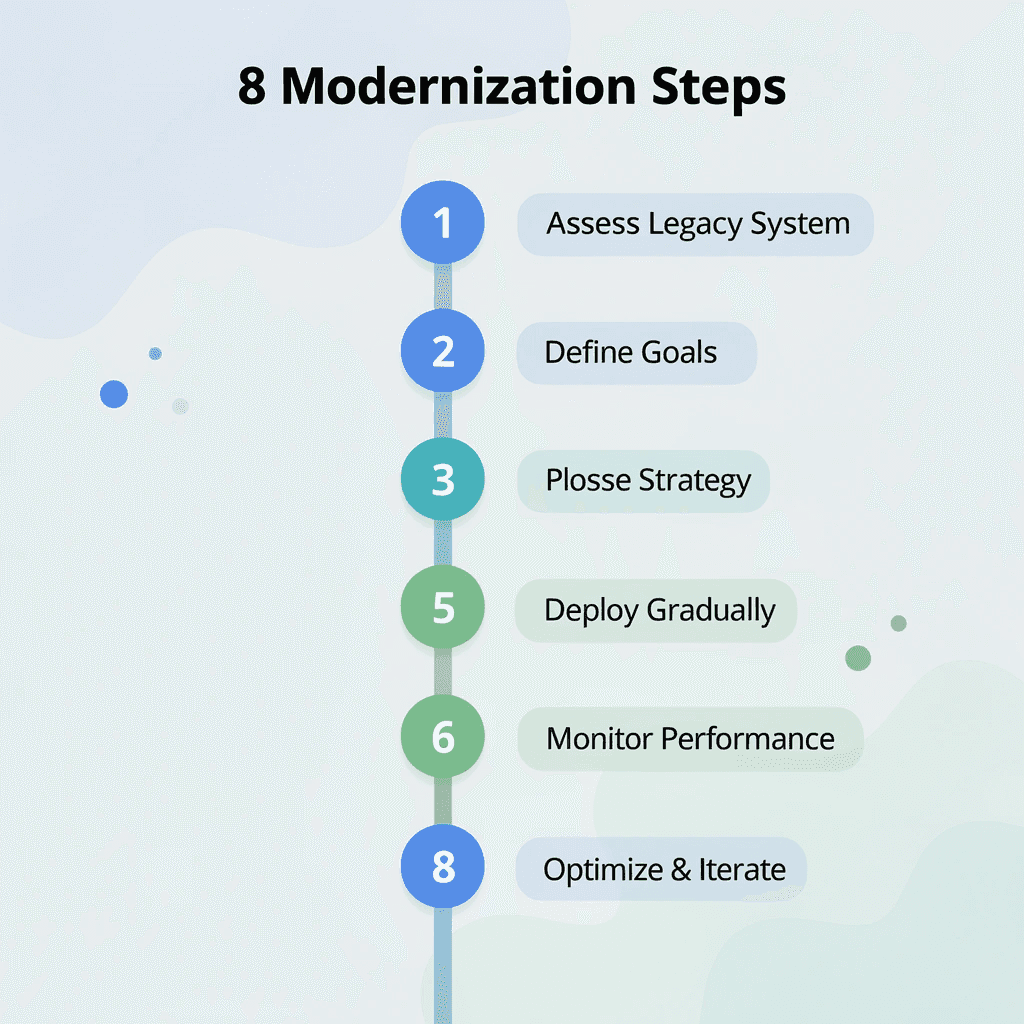
8 Steps for Successful Legacy System Modernization
Modernizing an old system requires a structured approach that reduces risk, preserves business continuity, and delivers measurable improvements at each stage. These eight practical steps provide a proven roadmap for transforming outdated systems into modern, scalable, and secure technology platforms.
"A structured modernization roadmap is the difference between a costly failure and a successful digital transformation that delivers lasting value." — Industry Best Practice
🎯 Key Point: The goal of legacy modernization isn't just replacing old technology — it's building a scalable, secure foundation that supports long-term business growth and operational resilience.
💡 Tip: Before jumping into execution, ensure every stakeholder understands the eight-step framework below — alignment at the start dramatically reduces risk and costly rework down the line.
|
Step Category |
Primary Goal |
Key Outcome |
|---|---|---|
|
Planning & Assessment |
Understand current state |
Risk reduction |
|
Strategy & Design |
Define the modernization path |
Scalable architecture |
|
Execution & Migration |
Transform the system |
Business continuity |
|
Validation & Optimization |
Ensure measurable success |
Secure, modern platform |
Step 1: Conduct a Comprehensive Assessment
Map out your entire technology landscape: applications, data flows, dependencies, and performance metrics. Evaluate business criticality, maintenance costs, security vulnerabilities, and alignment with current needs. This reveals hidden risks and the impact of outdated components, enabling you to prioritize efforts and build a data-driven foundation for the initiative.
Step 2: Define Clear Objectives and Success Metrics
Match modernization goals with specific business results: lower operational costs, quicker feature delivery, better customer experiences, or stronger compliance. Include stakeholders from IT and business units to set measurable KPIs such as downtime reduction targets or scalability benchmarks. Clear objectives prevent scope creep and ensure decisions advance strategic priorities.
Step 3: Develop a Phased Modernization Strategy
Pick the right approach for each system. You might rehoist, refactor, rebuild, or replace it. Base your choice on its complexity and value. Make a roadmap that shows timelines, what resources you need, and how you'll handle risks. Focus on the areas that will have the biggest impact first. This way, you can make changes without causing too much disruption while keeping everything running smoothly.
Step 4: Assemble the Right Team and Expertise
Bring together internal staff and external experts knowledgeable about the systems you want to implement and change management. Train your team on new tools and processes. A strong team ensures knowledge sharing, accelerates decision-making, and manages workflow changes that often determine project success.
Step 5: Select Tools and Technologies
Find platforms and frameworks that work with your setup, scale with your needs, and solve specific problems like data migration or cloud integration. Evaluate options for security, performance, and long-term maintainability. The right technology stack accelerates development and prevents technical debt.
Step 6: Execute Incremental Implementation with Testing
Roll out changes in controlled phases using strangler patterns to gradually replace old components. Perform thorough testing at each stage, including automated regression and performance validation. This approach delivers early wins, enables real-time adjustments, and protects core operations from large-scale failures.
Step 7: Leverage Specialized Platforms for Acceleration
Platforms like CodeGiant help teams modernize legacy business systems by building production-ready applications, agents, and workflows. Our enterprise AI platform enables system migration, AI-driven automation, and seamless integration with tools such as Salesforce, Postgres, and AWS, allowing organizations to maintain full control, ensure compliance, and accelerate deployment from prompt to production.
Step 8: Monitor, Optimize, and Scale
Set up ongoing monitoring with performance dashboards and feedback loops after launching the system. Analyze the results against your original KPIs and iteratively improve the solution. This locks in value through continuous improvement and prepares the system for future needs. Organizations that follow these steps systematically replace legacy constraints with modern capabilities that power innovation and efficiency.
How to Measure the Success of a Legacy System Modernization Project
The real measure of success comes after deployment, when you can prove the investment improved business performance, reduced costs, strengthened security, and made your organization more agile. Tracking the right metrics ensures your modernization initiative delivers measurable business value instead of simply replacing old technology with newer technology.
"The true test of any legacy modernization project is not whether the new system works — it's whether the business performs better because of it." — Industry Best Practice
💡 Tip: Define your success metrics before deployment — not after. Organizations that establish clear KPIs upfront are far better positioned to prove ROI and justify the investment to stakeholders.
⚠️ Warning: Avoid the common mistake of measuring success by technical milestones alone. If you can't demonstrate reduced operational costs, improved agility, or a stronger security posture, your modernization project has not truly succeeded.
|
Success Dimension |
Key Metric to Track |
|---|---|
|
Business Performance |
Revenue impact, productivity gains |
|
Cost Reduction |
Operational savings, maintenance spend |
|
Security Strength |
Vulnerability reduction, compliance rate |
|
Organizational Agility |
Deployment speed, time-to-market |

Financial Return on Investment
Calculate ROI by comparing total modernization costs against the savings and new revenue opportunities achieved over time. Track reductions in maintenance expenses, infrastructure spending, and overall total cost of ownership. According to industry analyses, some mainframe modernization initiatives deliver 288 to 362 percent ROI within three to five years.
Operational Efficiency Gains
Watch how your system performs, how often you deploy updates, and how many resources you use after modernization. Track faster processing times, higher throughput, and lower error rates. Successful projects achieve 30 to 40 percent reductions in IT maintenance costs and enable 50 percent faster time-to-market for new features in sectors like banking. These gains streamline workflows and increase capacity to handle business demands without proportional increases in staffing or hardware.
System Reliability and Uptime
Check your system's availability, incident frequency, and mean time to resolution. These metrics measure stability improvements. Modern systems experience higher uptime and fewer unexpected breakdowns. Projects prioritizing reliability often see 50 to 80 percent reductions in incidents, making operations more predictable. This builds customer trust and reduces emergency support costs.
Developer Productivity and Agility
Track metrics like time spent on maintenance versus new development, release cycle speed, and team velocity. After modernization, teams dedicate more effort to innovation as technical debt decreases and tools become more intuitive. Organizations see developer proficiency improvements of around 20 percent in AI-assisted cases, with faster iteration cycles that accelerate feature delivery and market adaptation.
Security and Compliance Posture
Look at how many security problems are resolved, how well audits are conducted, and whether the organization complies with regulations. New platforms offer better protections and record-keeping than older systems. You know it's working when data breach risk decreases, compliance costs drop, and the organization adapts to new requirements more easily.
Business and Customer Impact
Track user satisfaction, revenue from new features, and adoption of updated tools. Demonstrate how modernization supports broader goals such as improved customer experiences and new digital services. Projects aligned with business objectives drive 2.5 times more revenue growth in competitive industries.
Scalability and Future Readiness
Test how well the system handles increased workload, new technology, and emerging ideas such as AI and analytics. Good modernization creates flexible designs that grow without requiring major changes. Measuring progress against these goals ensures legacy modernization projects perform optimally and creates a repeatable plan for future technology projects.
How CodeGiant Helps Enterprises Modernize Legacy Systems Faster
A critical gap in modernization emerges when teams move from working prototypes into production, a transition far larger than most people expect. This shift is not a simple technical handoff; it represents one of the most underestimated risks in any enterprise modernization initiative.
"The jump from prototype to production is the defining moment where modernization efforts succeed or collapse — and most teams are unprepared for it." — Enterprise Architecture Insight
🎯 Key Point: The prototype-to-production gap is not a minor hurdle but a fundamental design flaw in how most enterprises approach legacy modernization.
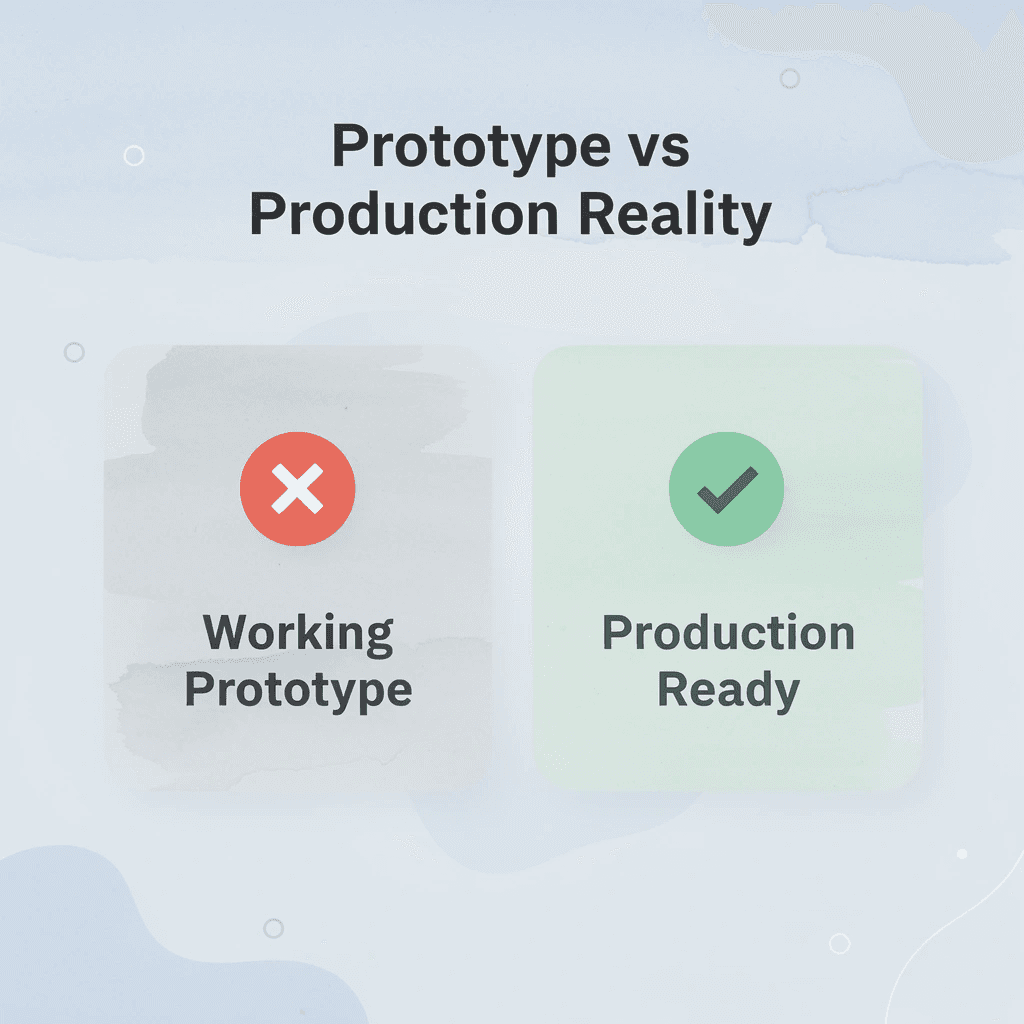
That gap costs real money. According to DreamFactory's Legacy System Modernization research, enterprises spend up to 80% of their IT budgets maintaining legacy systems, leaving little for competitive advancement. Most modernization approaches treat production readiness as a destination rather than a design constraint built into every step of the process.
|
Modernization Approach |
Production Readiness |
Budget Impact |
|---|---|---|
|
Traditional Approach |
Treated as a final destination |
Up to 80% is consumed by maintenance |
|
Design-First Approach |
Built in at every step |
Free budget for competitive advancement |
💡 Tip: Enterprises that embed production readiness as a design constraint — not an afterthought — dramatically reduce the cost of legacy maintenance and accelerate time-to-value.
⚠️ Warning: If your team is still treating production readiness as the last phase of modernization, you are actively draining your IT budget with no competitive return.
Where traditional pipelines break down
The failure point is usually dependency mapping. Legacy codebases—particularly COBOL-based systems in banking, insurance, and government—carry decades of embedded business logic documented only in the code itself. Manual extraction takes months to determine what the system does before teams can decide what to change. Cognizant's legacy modernization research shows that gen AI-powered code understanding can reduce modernization time by up to 40% by compressing this discovery bottleneck.
Why do parallel workstreams stall legacy system modernization efforts?
Most teams run parallel workstreams: one maintaining the legacy system, another attempting migration. The hidden cost is coordination friction. Decisions in one workstream break assumptions in the other; months pass, budgets stretch, and the business sees no production deployment.
How does building on the legacy stack change the modernization outcome?
CodeGiant treats legacy technology stacks as a foundation rather than an obstacle. Teams connect existing systems like Postgres, Salesforce, or core banking platforms directly into modernization pipelines, then use the App Builder, Agent Builder, and Workflow Builder to create production-ready services with automatic dependency resolution. The result deploys with full compliance controls, one-click deployment to AWS ECS or Azure Container Apps, and built-in audit trails.
What "incremental" actually means in practice
Incremental modernization isn't slow modernization. A COBOL file like ACCNT_PROC.cbl moving through automated logic extraction, dependency resolution, and conversion to a containerized service on Google Cloud Run represents a complete, validated unit of work that ships. The next one ships. The system evolves without a multi-year freeze on new capabilities. Each deployment is a checkpoint, not a gamble, fundamentally changing how regulated industries approach risk tolerance. The real question isn't whether your legacy systems can be modernized, but whether your platform was built to make production readiness the default.
Related Reading
- Application Modernization Roadmap
-
Insurance Legacy Modernization
-
.net Modernization
-
Enterprise Architecture Modernization
-
Cobol Replacement
-
Iseries Modernization
-
Application Modernization Benefits
-
Rpg Modernization
Try CodeGiant's Enterprise AI Platform Today
Old systems won't update themselves. Teams that treat modernization as a controlled, step-by-step process can improve existing systems, automate the movement of data and applications, and launch production-ready apps without stopping operations. CodeGiant gives companies in financial services, healthcare, insurance, and other industries the tools to move away from old system limits to production-ready workflows through App Builder, Agent Builder, and one-click deployment to AWS, Azure, or Google Cloud.
"Teams that treat modernization as a controlled, step-by-step process can improve existing systems, automate data movement, and launch production-ready apps — without stopping operations." — CodeGiant Platform Overview
🎯 Key Point: CodeGiant's platform supports three core deployment targets — AWS, Azure, and Google Cloud — giving enterprise teams full flexibility with zero vendor lock-in.
|
Tool |
Primary Function |
Industries Served |
|---|---|---|
|
App Builder |
Build and launch production-ready apps |
Financial Services, Healthcare, Insurance |
|
Agent Builder |
Automate workflows and data movement |
All enterprise verticals |
|
One-Click Deployment |
Deploy to AWS, Azure, or Google Cloud |
Any cloud-ready organization |
⚠️ Warning: Skipping a controlled modernization process and opting for rip-and-replace approaches can halt operations, spike costs, and introduce significant risk — CodeGiant is built to eliminate exactly that.
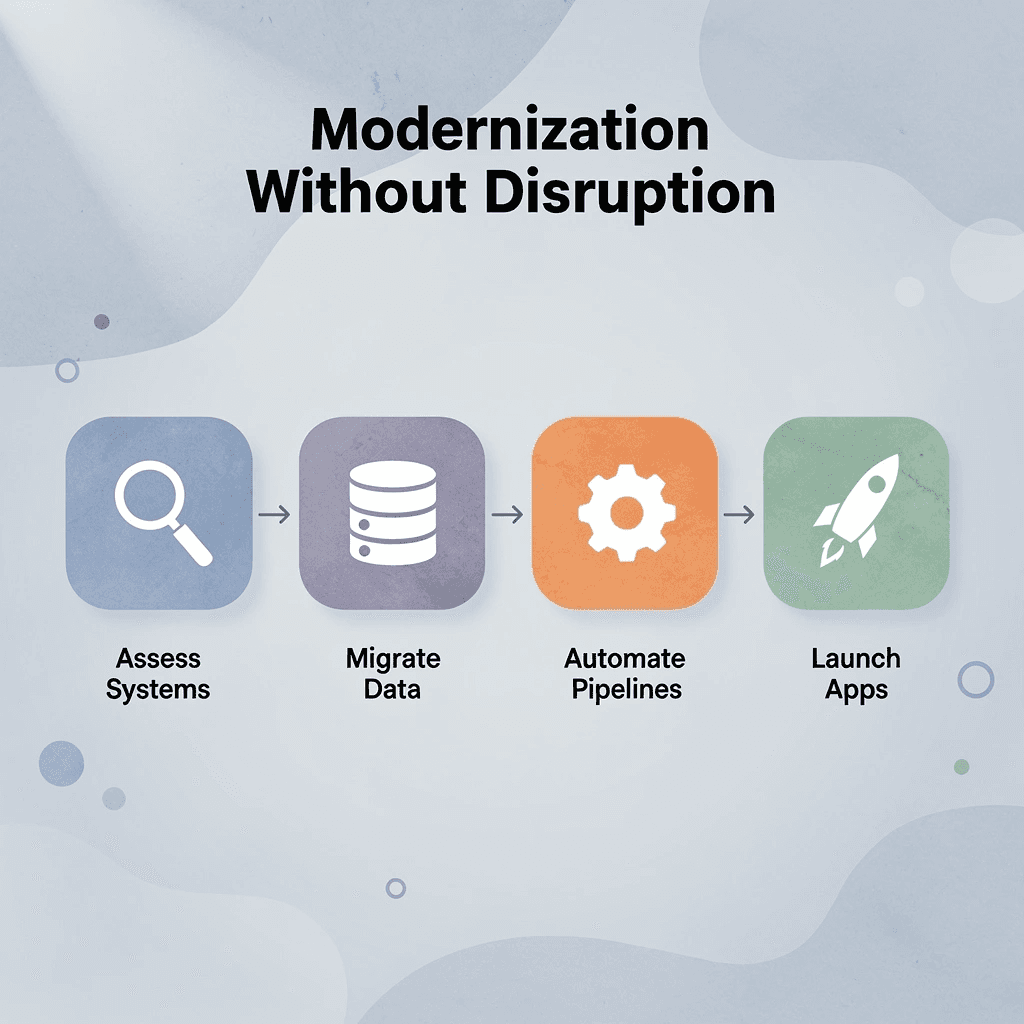
Visit CodeGiant to see how a controlled modernization pipeline can take shape without heavy upfront commitments or rip-and-replace risk.
💡 Tip: Getting started with CodeGiant requires no massive infrastructure overhaul. Explore the platform to find a low-risk entry point that fits your team's current modernization stage.