Many organizations still run critical business logic on COBOL systems built decades ago. Migrating that legacy mainframe code to modern Java is one of the most complex challenges in Application Modernization Tools today, touching everything from source code conversion and data structure mapping to runtime behavior and business rule preservation. Getting it right requires a structured approach that keeps embedded logic intact while minimizing operational disruption.
Manually rewriting thousands of lines of procedural COBOL into object-oriented Java is time-consuming and error-prone. Automating that process, without sacrificing the business rules your systems depend on, is where the right tooling makes a measurable difference. Teams looking to modernize COBOL systems safely and at scale can find a practical starting point with CodeGiant's enterprise AI platform.
Table of Contents
-
Why Are Organizations Migrating From COBOL to Java?
-
Should You Rewrite, Refactor, or Automatically Convert COBOL to Java?
-
How Can AI Accelerate COBOL To Java Migration?
-
9 Steps to Modernize Legacy Systems With COBOL To Java Migration
-
Features to Consider When Choosing a COBOL To Java Migration Platform
-
How CodeGiant Simplifies COBOL To Java Migration
-
Try CodeGiant's Enterprise AI Platform Today
Summary
-
The COBOL talent shortage is accelerating migration timelines in ways many organizations did not anticipate. The average COBOL programmer is 55 years old, and roughly 10% of that workforce retires each year. Hiring cycles for specialist replacements already run 90 to 180 days, and consultant rates reflect that growing scarcity. Java, by contrast, draws from one of the largest active developer communities in the world, where training pipelines and tooling evolve continuously.
-
Maintenance costs alone are forcing modernization decisions at many organizations. Budgets exceeding $500,000 per year in legacy upkeep are identified as a key trigger for migration planning, and that figure typically understates the real exposure. Hidden costs, including productivity loss, compliance gaps, and security risk in hybrid environments, are often distributed across separate budget lines and only become visible when someone finally aggregates them.
-
Automated COBOL-to-Java translation tools handle roughly 80% of code conversion, but the remaining 20% contains the most complex, business-critical logic in the system. The output code compiles and runs, but it carries procedural structure and flat data patterns into Java files that no Java developer wants to maintain. That structural mismatch is why automated conversion alone rarely produces a system that is genuinely easier to own than the one it replaced.
-
AI significantly compresses the most time-intensive phases of migration, including code analysis, syntax translation, test generation, and data mapping. Over 800 billion lines of COBOL code remain in active use globally, making manual-only approaches economically indefensible at enterprise scale. Organizations using AI-driven conversion tools have reported up to 60% reductions in migration time, with most of that compression coming from catching errors during migration rather than discovering them after cutover.
-
Data mapping is where most migrations quietly break, even when code conversion goes smoothly. COBOL data structures carry decades of encoding assumptions, including packed decimal fields, fixed-length records, and VSAM dependencies, that do not translate cleanly into relational or API-accessible formats. Automated approaches that handle referential integrity as a formal migration step can achieve up to 40% cost savings compared to conventional programs, largely by eliminating the manual verification cycles that poor data mapping forces downstream.
-
A completed migration and a genuinely modernized system are not the same thing. Converted Java code that simply replicates COBOL behavior is a better-maintained version of the same limitation, not a foundation for AI agents, modern APIs, or new services. The organizations that see compounding returns from modernization are the ones that plan for what gets built on top of the migrated codebase, not just the migration itself.
-
CodeGiant's enterprise AI platform addresses this by combining automated logic extraction and dependency resolution with governed deployment across major cloud providers, so migrated Java code becomes a foundation teams can build on rather than a translation artifact they have to manage.
Why Are Organizations Migrating From COBOL to Java?
A patch here, a workaround there, and then one day your most experienced COBOL developer announces retirement and takes thirty years of undocumented system knowledge with them. That moment forces the migration conversation — and it's a moment more organizations are facing every year as the COBOL talent pool shrinks and legacy system risk reaches a tipping point.
"The average COBOL developer is over 55 years old — meaning organizations are one retirement wave away from losing decades of irreplaceable institutional knowledge." — Industry Analysis
|
Migration Driver |
The Real Risk |
|---|---|
|
Aging COBOL workforce |
Undocumented logic disappears at retirement |
|
Shrinking talent pool |
Fewer developers = higher costs and longer fix times |
|
Legacy system fragility |
Every patch increases technical debt |
|
Java ecosystem growth |
Modern tooling, cloud-readiness, and active community support |
💡 Tip: Don't wait for a retirement announcement to start your migration plan. The best time to act is before the knowledge walks out the door.
⚠️ Warning: Undocumented COBOL logic is one of the most underestimated risks in enterprise IT. If your systems can't be explained without a specific person in the room, your organization is already in a vulnerable position.
🔑 Takeaway: The migration from COBOL to Java isn't just a technology upgrade — it's a business continuity decision driven by workforce reality, system maintainability, and the need to stay competitive in a rapidly modernizing landscape.

The talent clock is already running
According to the Astadia Blog, the average COBOL programmer is 55 years old, with about 10% of the workforce retiring annually. Organizations report that hiring for specialist roles takes 90 to 180 days, and consultant rates reflect the scarcity of these workers. Java, by contrast, has one of the largest active developer communities in the world, with continuous talent training and tools that evolve to meet modern infrastructure needs.
When do maintenance costs outgrow their value?
The same pattern shows up across banking, insurance, and government IT departments: maintenance budgets keep growing while systems stay the same. Modernization Intel identifies maintenance costs exceeding $500,000 per year as a key reason for migration decisions. Hidden costs—productivity loss, compliance exposure, and security risk in hybrid legacy environments—often make the real number significantly higher. Most organizations discover this only after consolidating expenses that have been spread across separate budget lines for years.
How does COBOL-to-Java migration break the cycle of compounding workarounds?
Teams typically respond by handling pain step by step: adding interfaces, building middleware wrappers, and fixing breaks. As integration demands grow and regulatory requirements tighten, workarounds accumulate into systems nobody fully understands and everyone fears to touch. Our enterprise AI platform at CodeGiant changes this by automating code analysis, dependency mapping, and language translation throughout the COBOL-to-Java migration lifecycle, enabling teams to move with confidence rather than caution.
The real cost is what you cannot build
Slow development cycles carry a strategic cost: when adding features or responding to regulatory changes takes months instead of weeks, organizations compete on endurance rather than capability. Java's object-oriented architecture, mature frameworks, and cloud-native compatibility enable microservices, real-time APIs, and integration with AI-driven tools that modern enterprises require. COBOL-to-Java migration is the foundational step that determines whether your organization can participate in next-generation production systems or remain stuck, with every proof of concept stalling. Knowing why to migrate and executing it without disrupting operations are fundamentally different challenges.
Related Reading
- Build Internal Tools
-
Cobol Modernization
-
Mainframe To Cloud Migration
-
Legacy Software Modernization
-
Cobol To Java
-
Build Internal Tools
-
Application Modernization Best Practices
-
Technical Debt Management
-
Ai Governance
-
Legacy System Modernization
Should You Rewrite, Refactor, or Automatically Convert COBOL to Java?
Rewriting gives the cleanest result but is the most expensive option. Refactoring reduces risk and keeps proven logic working, making it ideal for systems that must keep running without problems. Automatic conversion looks fast on paper, but it costs a lot in real life.
"The cheapest option upfront is rarely the least expensive option in the long run — hidden costs in automatic conversion can quickly outpace the investment in a proper rewrite or refactor." — Industry Best Practice
|
Approach |
Key Benefit |
Key Drawback |
|---|---|---|
|
Rewrite |
Cleanest, most modern result |
Most expensive option |
|
Refactor |
Reduces risk, preserves proven logic |
Slower transformation |
|
Automatic Conversion |
Appears fast on paper |
High hidden costs in practice |
💡 Tip: If your system cannot afford downtime, refactoring is your safest path — it keeps proven logic intact while modernizing incrementally.
⚠️ Warning: Don't let the apparent speed of automatic conversion fool you — what looks like a quick win often becomes a costly maintenance burden down the line.

What automatic conversion actually produces
Automated COBOL-to-Java translation tools handle about 80% of code automatically, according to a Stack Overflow user experience report on COBOL migration, with the remaining 20% requiring manual work. That 20% contains the most complex, business-critical logic your system runs on. The output code compiles and executes but carries COBOL's structural DNA into Java: procedural flow, flat data structures, and zero object-oriented design. You end up owning Java code that no Java developer wants to maintain.
Why does COBOL-to-Java refactoring earn its reputation?
Organizations that modernize successfully identify high-friction modules, rewrite them in Java with proper design, and run both systems in parallel until confident. This step-by-step approach maintains production stability while building genuine Java capability over time. It's slower than a full rewrite in theory, but it rarely stalls the way big-bang projects do.
How do hidden dependencies threaten COBOL-to-Java migration work?
Most teams track dependencies by hand using spreadsheets and shared knowledge, creating blind spots where unwritten dependencies can derail weeks of migration work. Platforms like CodeGiant address this by enabling teams to build, manage, and extend modernization workflows within their current tools, maintaining compliance and operational control throughout the transformation rather than discovering problems after deployment.
When a full rewrite actually makes sense
A complete rewrite makes sense when the existing system is too tangled to fix cleanly, and the business has sufficient resources to complete it. The Stack Overflow community's data on legacy migration timelines shows that most large COBOL-to-Java rewrite projects take two to five years. Successful teams treat it like building a new product, not translating code. They hire Java architects who understand the business, not just the programming language. Without that combination, the rewrite creates a new system with the same structural problems as the old one.
How do you choose the right COBOL-to-Java migration path?
The choice among these three paths comes down to one question: how well documented is your current system's logic for surviving a rebuild? If the answer is "most of it," a rewrite is possible. If the answer is "we're not sure," refactoring is the safer choice. If the answer is "almost none of it," automated conversion will worsen the problem.
How Can AI Accelerate COBOL To Java Migration?
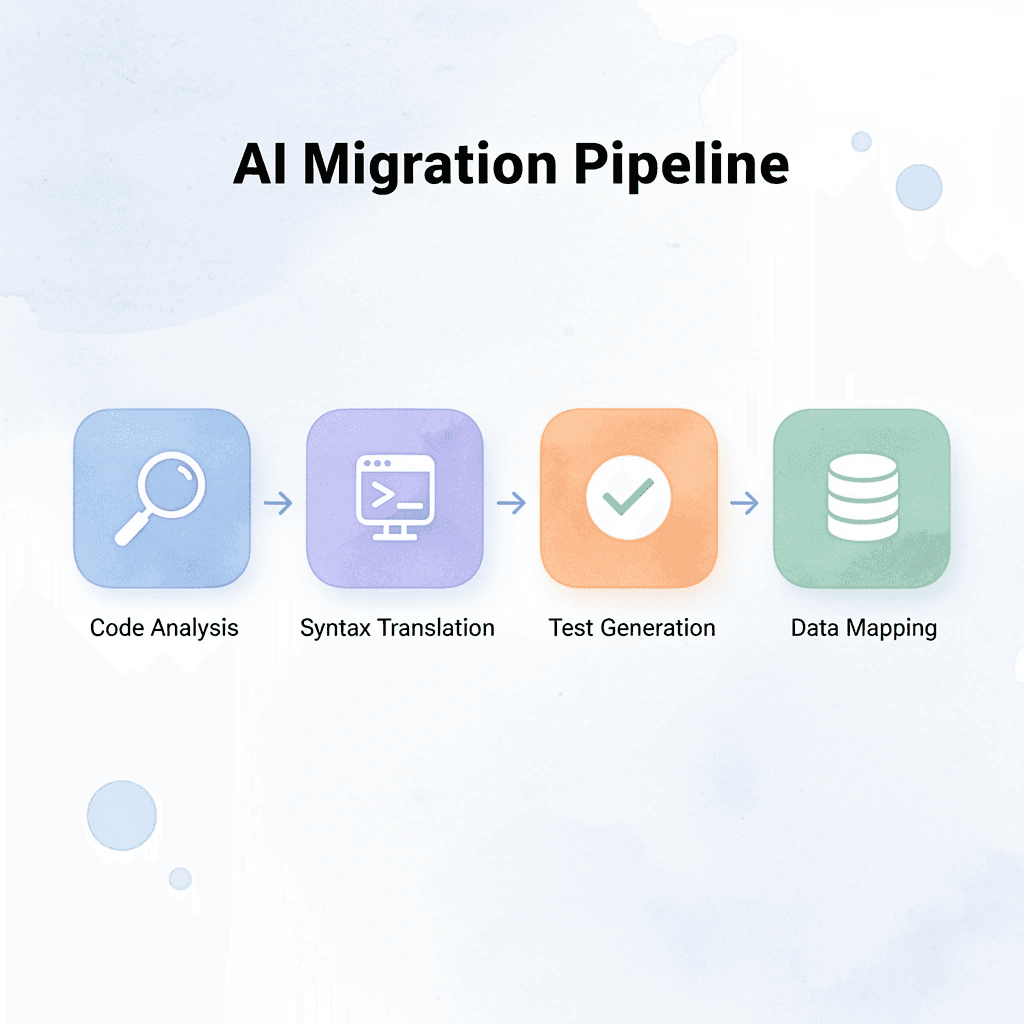
AI speeds up the process of changing COBOL code to Java by making code analysis, syntax translation, test generation, and data mapping dramatically faster. AI can read procedural logic on a large scale and create structured output that human engineers check rather than build from the beginning. This reduces work that used to take hundreds of developer-hours to just a few days.
"AI-driven migration reduces work that once consumed hundreds of developer hours down to just a few days — transforming COBOL-to-Java conversion from a multi-month ordeal into a streamlined, engineer-reviewed process." — Key Industry Insight
|
Migration Task |
Traditional Approach |
AI-Accelerated Approach |
|---|---|---|
|
Code Analysis |
Manual review, weeks of effort |
Automated scanning in hours |
|
Syntax Translation |
Line-by-line developer rewrite |
AI-generated structured output |
|
Test Generation |
Handcrafted test cases |
Automatically produced test suites |
|
Data Mapping |
Manual schema alignment |
AI-assisted mapping at scale |
💡 Tip: Leverage AI-generated structured output as a first draft — your engineers should focus on reviewing and refining, not building from scratch, to maximize time savings.
⚠️ Warning: Don't skip the human review stage. AI accelerates every phase of COBOL-to-Java migration, but critical business logic must be validated by experienced engineers to avoid costly runtime errors.
What does AI actually do that humans cannot do fast enough?
The failure point in most legacy migrations is volume, not ambition. A typical enterprise COBOL codebase contains millions of lines of tightly coupled procedural logic, with business rules embedded in batch jobs, file input/output routines, and report generators that were never documented. AI parses this at a speed no team of developers can match, mapping data flows, identifying dead code, and flagging interdependencies that cause silent failures during cutover. According to InfoSprint's analysis of COBOL-to-Java migration risks, over 800 billion lines of COBOL code remain in active use globally, making manual-only approaches economically indefensible.
How does AI consistently handle the COBOL-to-Java translation layer?
The translation layer is where AI does its most visible work. Packed decimal arithmetic, EBCDIC character encoding, VSAM file structures, and PERFORM-based control flow all have Java equivalents, but mapping them correctly across thousands of programs requires pattern recognition that humans cannot sustain without accumulating errors. AI applies conversion logic consistently across every file rather than relying on individual developers to remember edge cases.
Why does continuous equivalence testing during COBOL to Java migration reduce errors?
Most teams write unit tests after migration is mostly complete—exactly backward. By the time differences show up in parallel runs, tracing them back to a specific translation decision is costly. AI-generated test suites built from original COBOL behavior enable continuous equivalence testing during migration, not after. CLPS Incorporation reports a 60% reduction in migration time using AI-driven COBOL-to-Java conversion tools, with that compression coming directly from catching errors early rather than discovering them in production.
Where does human expertise still matter?
AI can handle large amounts of data and find patterns; humans can make judgments and understand the consequences of decisions. AI will translate a COBOL paragraph accurately, but it cannot tell you whether that paragraph still aligns with current business policy or whether it was a 1987 workaround that nobody has changed since. That distinction requires field expertise.
How do platforms support production-safe COBOL to Java output?
Platforms built for production-grade modernization, like CodeGiant, are designed around this reality: they provide teams with the infrastructure to manage AI-assisted transformation while maintaining compliance controls and audit trails, ensuring output is production-safe, reviewable, and extensible Java that supports APIs, agents, and new application layers without starting over.
Why does incremental migration make the human-AI division of labor most visible?
Incremental migration makes this human-AI division of labor most visible. Rather than translating an entire system in a single high-risk moment, AI enables component-by-component transformation, with each module converted, tested, and validated before the next begins. Financial institutions and government agencies running child support systems, tax platforms, or claims processing cannot afford a failed cutover. Running legacy COBOL and new Java components in parallel, with AI managing the integration layer, makes modernization practical for organizations where downtime carries regulatory consequences. The hardest part of this migration has nothing to do with code at all.
Related Reading
- As400 Modernization
- Enterprise Ai Governance
- Public Sector Digital Transformation
- Mendix Alternatives
- OutSystems Alternatives
- Appian Pricing
- Ai Agent Pricing
- Outsystems Vs Mendix
9 Steps to Modernize Legacy Systems With COBOL To Java Migration
Modernizing old COBOL applications requires more than just translating the code. Successful migrations follow a structured process that protects decades of business logic, minimizes operational risk, and enables cloud-native development and long-term scalability. The nine steps below provide that foundation.
"Successful COBOL to Java migrations are never just a code translation exercise — they are a full-scale business transformation that demands structure, discipline, and a clear modernization roadmap." — Industry Best Practice
|
Migration Priority |
What It Protects |
Why It Matters |
|---|---|---|
|
Business Logic Preservation |
Decades of encoded rules |
Prevents costly regressions |
|
Operational Risk Management |
Live system continuity |
Ensures zero downtime |
|
Cloud-Native Enablement |
Future scalability |
Unlocks modern infrastructure |
|
Structured Process |
End-to-end consistency |
Reduces migration failure rates |
💡 Tip: Before writing a single line of Java, document and validate every piece of existing COBOL business logic — this is the most critical step teams skip.
🎯 Key Point: A structured nine-step migration framework is essential for any organization looking to modernize legacy COBOL systems without sacrificing stability, performance, or long-term scalability.
Step 1: Conduct Comprehensive System Assessment
Create a complete inventory of all COBOL code, including programs, copybooks, databases, and connected items such as JCL scripts or IMS/VSAM files. Use code analysis tools and AI-assisted scanners to assess code complexity, identify unused code, and map interdependencies. This establishes a verified baseline, quantifies technical debt, and highlights high-risk areas, such as tightly coupled modules that process core transactions. Often, 20-30% of code requires special attention due to unique business rules.
Step 2: Define Migration Strategy and Roadmap
Create a plan aligned with your business goals. Choose between migrating everything at once, incrementally, or using a hybrid approach. Consider your timeline, budget, risk tolerance, and Java architecture preference—such as Spring Boot for microservices or cloud-based deployments. Develop a detailed plan with checkpoints, assign resources, and establish measurable objectives, such as reducing operational costs or accelerating time-to-market. Consult IT staff, operations teams, and business leaders to ensure the migration supports compliance and sustainable growth.
Step 3: Set Up the Modernization Environment
Get your Java setup ready by choosing frameworks, IDEs, and cloud platforms that work well together. Set up your development, testing, and staging environments with tools to manage dependencies, control versions, and run CI/CD pipelines. Plan your data migration, including converting data structures from legacy formats into relational databases such as PostgreSQL or Oracle. Train your team on Java best practices and leverage AI coding assistants to accelerate development.
Step 4: Perform Detailed Analysis and Documentation
Use AI to automatically document how your business works, create flow diagrams, and extract rules from COBOL procedures. Analyze data flows, screen layouts, and batch processes to create detailed plans for the Java version. This uncovers hidden assumptions in legacy code and produces documentation that guides developers. Strong documentation accelerates knowledge transfer as experienced COBOL experts retire and provides a reference for validating work throughout the project.
Step 5: Prioritize Applications and Modules for Migration
Rank components based on business value, maintenance costs, risk, and dependencies, starting with customer-facing or high-maintenance modules while deferring stable batch jobs. Use portfolio analysis to identify quick wins that deliver early return on investment. This phased approach enables parallel operation of legacy and modern systems while building team confidence on isolated modules before tackling core transactional systems.
Step 6: Execute Automated Code Conversion and Refactoring
Use AI-powered translation tools to convert COBOL syntax into clean, readable Java code. Map constructs like PERFORM loops to Java methods or streams and data divisions to POJOs. Refactor for object-oriented design using patterns such as dependency injection and RESTful services. While automation handles repetitive code efficiently, experts review and optimize complex logic to ensure maintainability and performance.
Step 7: Migrate Data and Implement Integrations
Convert EBCDIC encodings, reorganize files or databases, and establish ETL processes to replace old data storage systems while ensuring accuracy. Build connection layers using APIs or middleware to link the new Java application with legacy systems and external programs. Rigorous data validation and reconciliation processes maintain information integrity during migration, including live syncing for systems running both old and new technology simultaneously.
Step 8: Conduct Rigorous Testing and Validation
Do multi-level testing: unit tests for individual modules, integration tests for system interactions, and parallel runs comparing outputs between COBOL and Java versions using identical inputs. AI can help generate test cases and identify edge scenarios. User acceptance testing with business stakeholders confirms functional equivalence and performance benchmarks. Address discrepancies iteratively to achieve high confidence before full deployment.
Step 9: Deploy, Monitor, and Optimize Post-Migration
Roll out the Java system in stages: pilot, shadow mode, and then production, with robust monitoring of performance, security, and resource usage. Use modern DevOps practices and AI-driven analytics to improve continuously. Train maintenance teams and document the system to ensure long-term value through lower costs, greater agility, and easier future improvements.
Features to Consider When Choosing a COBOL To Java Migration Platform
Modernizing a COBOL application is a long-term investment that demands careful platform selection. The right migration platform keeps your business logic safe, reduces operational risk, speeds up modernization, and gets your applications ready for future innovation. Below are the most important features to evaluate.
"The right migration platform is not just a technical decision — it is a strategic business investment that determines whether your modernization succeeds or stalls." — Industry Best Practice
🎯 Key Point: Not all migration platforms are created equal. Choosing the wrong platform can put decades of critical business logic at risk — making feature evaluation an essential first step.
💡 Tip: Before committing to any platform, benchmark it against your specific COBOL codebase complexity, operational risk tolerance, and long-term innovation goals to ensure the best fit.
|
Feature Category |
Why It Matters |
|---|---|
|
Business Logic Preservation |
Protects decades of embedded rules and workflows |
|
Operational Risk Reduction |
Minimizes downtime and migration errors |
|
Modernization Speed |
Accelerates time-to-value for your Java environment |
|
Future Innovation Readiness |
Ensures the migrated app scales with new technology |

Accuracy in Code Translation and Logic Preservation
Choose platforms that deliver high fidelity in converting COBOL business rules into equivalent Java implementations. Look for tools that handle complex elements such as packed decimals, file handling, and conditional logic, while supporting object-oriented refactoring. Verify through proofs of concept how well they manage your custom logic, since accuracy directly reduces expensive rework during testing and deployment.
AI-Powered Analysis and Automation Capabilities
Focus on platforms with advanced artificial intelligence capabilities for automated dependency mapping, document generation, and smart code suggestions. Good tools read large codebases quickly, find patterns, and suggest modern Java designs such as microservices, reducing manual analysis time. Look for solutions that combine reliable automation with generative AI to deliver balanced results across simple and complex modules.
Comprehensive Testing and Validation Support
The best platforms include built-in or integrated testing frameworks that generate unit tests, enable parallel runs, and verify that the source and target systems operate identically. Automated test data creation and regression suites catch problems early. Thorough validation reduces production risks for transaction-heavy applications in finance or government. Ensure the tool supports improvements based on test results.
Data Migration and Integration Features
Look at how well the platform handles database changes, such as moving from VSAM or IMS to relational models, including encoding conversions and schema mapping. Strong integration capabilities enable hybrid environments where new Java components communicate securely with legacy systems via APIs or middleware, supporting phased rollouts without full rip-and-replace disruptions.
Scalability, Cloud Readiness, and Performance Optimization
Choose platforms designed for large business migrations that support cloud deployment targets and modern performance patterns. Look for features that decompose large applications into scalable Java applications, accelerate queries, and align with containerization standards like Docker and Kubernetes. The tool should provide monitoring hooks and post-migration recommendations to maintain or improve performance.
Security, Compliance, and Governance Controls
Migration platforms need robust security to handle code, maintain audit trails, and comply with regulated industry standards. Features like role-based access, encryption of sensitive data in transit, and change documentation help meet requirements such as GDPR and financial regulations.
Ease of Use, Support, and Total Cost of Ownership
Look at how easy the interfaces are to use, the quality of the documentation, and what training is available. Check the vendor's history with similar projects and their support model. Calculate total costs including licensing, infrastructure, training, and productivity gains. Platforms that accelerate timelines and reduce manual work typically offer greater long-term value despite a higher initial investment.
How CodeGiant Simplifies COBOL To Java Migration
COBOL migration fails not because of syntax conversion problems, but because of understanding invisible architecture: undocumented business rules that are built into decades-old batch jobs, referential logic that only retired engineers knew about, and unwritten compliance requirements. The gap between what the system does and what anyone can prove it should do is where migrations break down.
"The gap between what the system does and what anyone can prove it should do is where migrations break down — and where most COBOL-to-Java projects lose months, budgets, and trust."
|
Migration Challenge |
Root Cause |
Risk Level |
|---|---|---|
|
Undocumented business rules |
Embedded in legacy batch jobs |
🔴 Critical |
|
Referential logic gaps |
Known only to retired engineers |
🔴 Critical |
|
Unwritten compliance requirements |
Never formally recorded |
🟠 High |
|
Syntax conversion issues |
Surface-level translation errors |
🟡 Moderate |
💡 Tip: Before writing a single line of Java, invest in discovery-first methodology — mapping every undocumented rule, implicit dependency, and compliance assumption buried inside your legacy COBOL system.
⚠️ Warning: Treating COBOL migration as a purely technical exercise is the #1 reason projects fail. The real danger isn't the code you can see — it's the invisible business logic you can't.

How does logic extraction build a trustworthy COBOL-to-Java foundation?
CodeGiant analyzes the code before converting it, mapping dependencies and building a comprehensive overview of the entire COBOL codebase. It tracks procedure calls, data flow, and control paths, converting them into a readable specification. A batch processing module that previously required weeks of manual documentation can be mapped in hours. The output gives developers something to verify rather than trust blindly. This shift from opacity to clarity makes the remainder of the migration trustworthy.
Why does COBOL-to-Java conversion fail when remediation replaces planning?
Most teams generate Java code and then spend months cleaning it up, using automated output followed by manual fixes that shift risk from the old system to the new one. As complexity increases, cleanup work grows, timelines slip, and the new Java application accumulates technical debt before launch. Our enterprise AI platform breaks this cycle by combining AI-powered transformation with deterministic automation, delivering production-grade converted Java code on the first pass. CodeGiant helps teams eliminate months of manual cleanup work and reduce technical debt from day one.
How data integrity survives the transition
Data mapping is where most migrations break. COBOL data structures carry decades of encoding assumptions, packed decimal fields, fixed-length records, and VSAM dependencies that do not translate cleanly into relational or API-accessible formats.
How does COBOL-to-Java handle legacy data structures without loss?
CodeGiant manages referential integrity as a formal step in its migration checklist, changing legacy structures while exposing them through governed APIs without data loss. According to VRNeXGen's AI-Powered COBOL to Java Migration analysis, automated approaches can achieve up to 40% cost savings compared to conventional migration programs by eliminating manual verification cycles.
Why does parallel-run capability matter for regulated COBOL-to-Java migrations?
Good data mapping enables hybrid operations during cutover, with legacy COBOL and new Java components running simultaneously against the same data layer. For organizations in financial services or government, this parallel-run capability determines whether a migration gains approval or stalls in risk review.
From migrated code to agent-ready infrastructure
The key difference between finishing a migration and truly modernizing a system is what you can build on top of it afterward. Converted Java code that copies COBOL behavior is a better-maintained version of the same limitation. Real value emerges when migrated logic becomes the foundation for AI agents, modern automations, and new services that would be impossible to build on the old system. Most migration programs never plan for this step, where the investment either grows or stagnates. The question is whether the platform you choose is built to finish this journey.
Try CodeGiant's Enterprise AI Platform Today
The platform you choose shapes everything that follows. Teams that pick tools built only for code translation find themselves stuck at the finish line, with clean Java files but no path to the AI agents, APIs, and production workflows that made the migration worth funding. CodeGiant is built for the full journey — from automated logic extraction and dependency resolution through governed, one-click deployment across AWS, Azure, and Google Cloud — so the migrated codebase becomes a foundation you can actually build on.
"Teams that pick tools built only for code translation find themselves stuck at the finish line — with clean Java files but no path to the AI agents, APIs, and production workflows that made the migration worth funding." — CodeGiant
🎯 Key Point: Choosing a platform that handles only code translation leaves your team stranded. True migration success requires automated logic extraction, dependency resolution, and governed cloud deployment — all in one pipeline.
|
Capability |
Code-Translation-Only Tools |
CodeGiant |
|---|---|---|
|
Automated Logic Extraction |
❌ Limited |
✅ Full Support |
|
Dependency Resolution |
❌ Manual |
✅ Automated |
|
AI Agent & API Readiness |
❌ Not Included |
✅ Built-In |
|
One-Click Cloud Deployment |
❌ Not Available |
✅ AWS, Azure, GCP |
|
Production Workflow Integration |
❌ Out of Scope |
✅ End-to-End |
If your organization is ready to move COBOL business logic into maintainable, agent-ready Java without compliance risk or months of manual analysis, visit codegiant.io to see how the migration pipeline works against your systems.
💡 Tip: Don't wait for a compliance incident or a talent gap to force migration. The earlier you move legacy COBOL logic into a governed, modern pipeline, the more runway you have to build AI-ready workflows on top of it.
✅ Best Practice: Evaluate your migration platform against the full production journey, not just the initial code conversion. CodeGiant's end-to-end pipeline ensures your migrated codebase is a launchpad, not a dead end.
Related Reading
- Application Modernization Roadmap
-
Insurance Legacy Modernization
-
.net Modernization
-
Enterprise Architecture Modernization
-
Cobol Replacement
-
Iseries Modernization
-
Application Modernization Benefits
-
Rpg Modernization